


Table of Contents
Flexible Spaces are the antidote to the rigid, compartmentalized homes of the past. For generations, we designed our lives around static rooms: a dining room that was used twice a year, a guest room that gathered dust for 360 days, and a living room dominated by a television. But as we move deeper into the mid-2020s, the definitions of “home,” “office,” and “gym” have collapsed into a single, fluid entity.
The era of the “single-purpose room” is dead. The era of Flexible Spaces has arrived.
This shift is not merely a reaction to shrinking urban apartments or rising real estate costs—though those are factors. It is a fundamental evolution in how we inhabit our environments. We no longer want more square footage; we want more utility per square foot. We want homes that adapt to us, rather than forcing us to adapt to them.
In this extensive guide, we will explore the mechanics, the psychology, and the technology behind Flexible Spaces. From robotic furniture that hides in the ceiling to sliding walls that vanish at the touch of a button, we will uncover how multi-functional interior design is rewriting the blueprint of modern living.
The Driving Forces: Why Flexibility is the New Luxury
Why is the concept of Flexible Spaces exploding right now? It is the convergence of three global mega-trends.
1. The Urban Crunch
By 2050, nearly 70% of the world’s population will live in cities. Space is becoming the ultimate luxury commodity. In cities like Tokyo, New York, and London, a 400-square-foot apartment is the norm. To live comfortably in that footprint, the space must perform the heavy lifting of an 800-square-foot home. Flexible Spaces allow one room to do the work of three.
2. The Hybrid Work Revolution
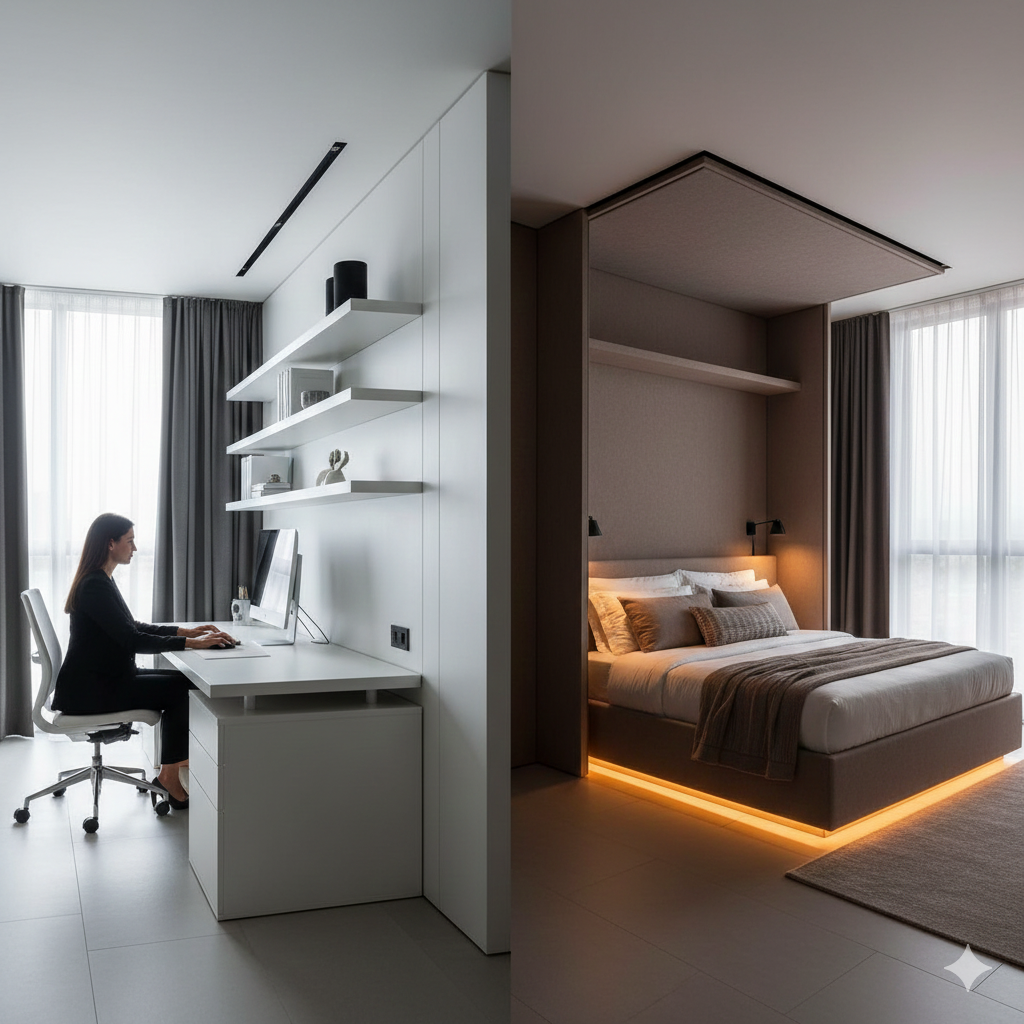
The pandemic changed everything. When the office moved into the home, the dining table became a desk, and the closet became a Zoom booth. Even as people return to the office, the hybrid model is here to stay. We need homes that can transition from “professional focus mode” at 10:00 AM to “family relaxation mode” at 6:00 PM. A static room cannot do this; only Flexible Spaces can.
3. The Experience Economy
Millennials and Gen Z value experiences over possessions. They don’t want a room filled with heavy, immovable mahogany furniture. They want lightweight, modular environments that can be cleared for a yoga session, a dinner party, or a VR gaming night.
The Architecture of Change: Moving Walls and Partitions
The most dramatic implementation of Flexible Spaces isn’t furniture; it’s architecture.
Traditionally, walls are permanent. In flexible design, walls are temporary. Architects are increasingly using:
- Pocket Doors & Sliding Partitions: These are not your grandmother’s rickety sliding doors. These are acoustic-rated, floor-to-ceiling architectural elements that can seal off a kitchen to hide the mess or open up a bedroom to join the living area.
- Pivot Walls: Large panels that rotate 360 degrees. One side might be a bookshelf; the other side a TV screen. By spinning the wall, you change the function of the room instantly.
- Bi-Folding Glass Walls: Bringing the outside in. By removing the visual barrier between the living room and the patio, the usable floor area effectively doubles during good weather.
The Furniture Revolution: Robotics and Transformers
If walls are the bones of Flexible Spaces, furniture is the muscle. We are moving far beyond the clunky Murphy beds of the 1980s.
Robotic Furniture (The Ori Living Model)
Companies like Ori Living (spun out of MIT Media Lab) are pioneering robotic interiors. Imagine a massive wooden unit that contains a bed, a closet, and a desk. With a voice command (“Alexa, time to sleep”), the unit glides across the floor, the bed extrudes from the bottom, and the lights dim. In the morning, it retracts to reveal a walk-in closet. This turns a studio apartment into a one-bedroom apartment on demand.
Modular Sofas
The “sectional” has evolved. Modern modular sofas are like LEGOs for adults. They consist of independent blocks that can be arranged as a movie pit, separated for conversation, or pushed together to form a guest bed. This adaptability is the hallmark of Flexible Spaces.
The Rise of the “Clofice”
The “Closet-Office” is a prime example of micro-flexibility. It is a dedicated workspace built into a closet nook. When the workday is done, you close the doors. The physical act of closing the doors provides a psychological separation between work and life, which is crucial for mental health in small spaces.
Zoning Without Walls: The Visual Tricks
Not every homeowner can tear down walls or install robots. You can create Flexible Spaces using “Soft Zoning”—using visual cues to define areas without physical barriers.
- Rug Zoning: A large area rug anchors a space. A rug under the sofa defines the “living zone.” A cowhide under the desk defines the “work zone.” Even in an open room, the brain reads these as separate rooms.
- Lighting Layers: Lighting is the quickest way to change a room’s function.
- Work Mode: Bright, cool overhead lighting (4000K).
- Relax Mode: Warm, low-level floor lamps (2700K).
- By putting these on different circuits (or using smart bulbs), you transform the atmosphere instantly.
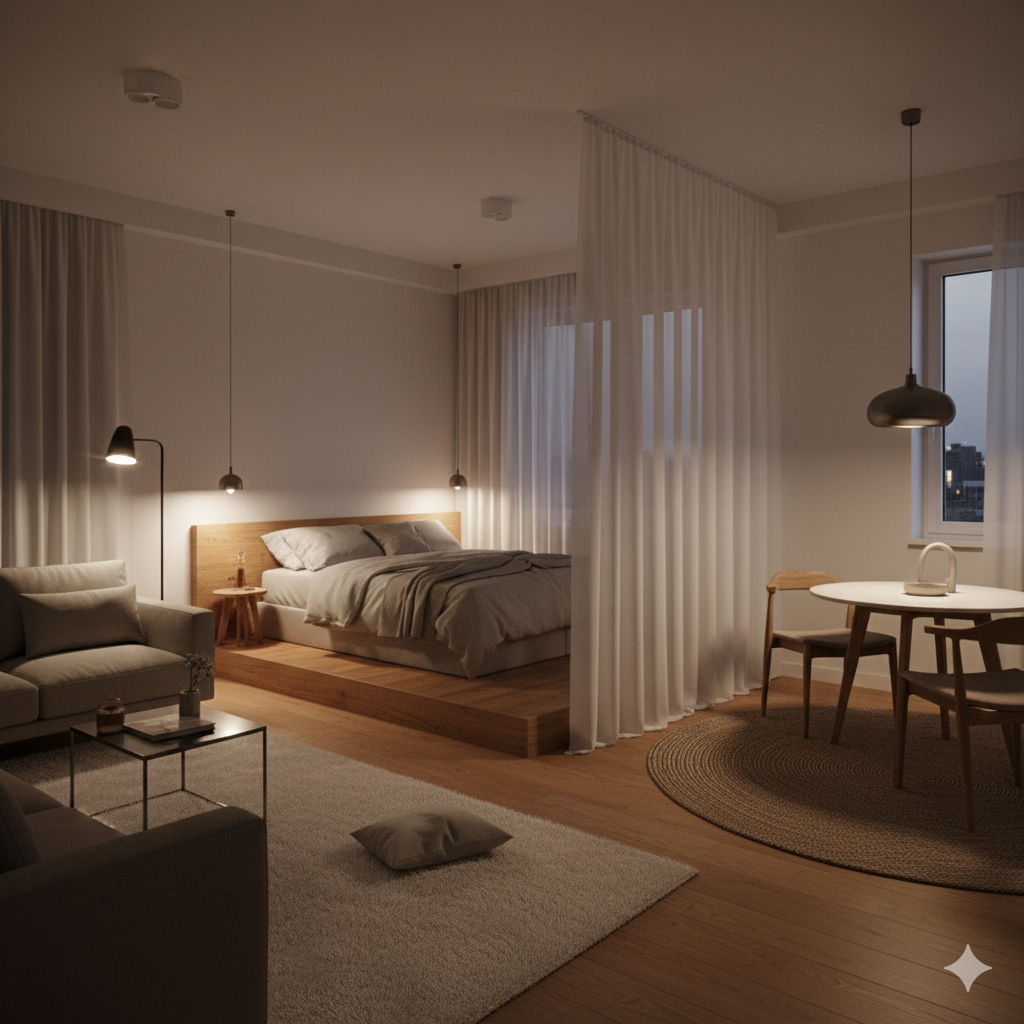
- Level Changes: Platforms are making a comeback. Placing the bed on a raised platform creates a distinct zone separate from the living area, and provides massive storage opportunities underneath (the “drawer step”).
The Psychology of Flexibility: Why It Feels Good
Flexible Spaces do more than save space; they save our sanity.
Human beings are cyclical creatures. We have different needs at 8:00 AM than we do at 8:00 PM. A static environment forces us to be the same person all day. A flexible environment allows us to “shed our skin.”
- The Ritual of Transformation: The act of converting a space—folding away the desk, lowering the bed—serves as a transition ritual. It signals to the brain that “Work is over; Rest begins.” In a world where digital notifications follow us everywhere, these physical rituals are vital for establishing boundaries.
- Control and Agency: Research in environmental psychology shows that having control over one’s environment reduces stress. Being able to move a wall or dim a light gives the occupant a sense of agency, making the home feel like a sanctuary rather than a cage.
Case Studies: Who Is Doing It Right?
1. The “Switch” Apartments (Tokyo)
In Tokyo, where space is at a premium, developers are building apartments with no fixed internal walls. Instead, they use a grid of sliding “fusuma” screens. A 50-square-meter apartment can be one massive party hall, or divided into four tiny private rooms for sleeping. This follows the traditional Japanese concept of Ma (negative space).
2. LifeEdited (New York)
Graham Hill, the founder of Treehugger, created the “LifeEdited” apartment in NYC. In just 420 square feet, he fits a dinner party for 12, two guest beds, and a home office. How? Flexible Spaces. He uses a telescoping dining table that collapses into a console, stacking chairs, and a moving wall that reveals bunk beds.
Sustainability: The Hidden Benefit
There is a massive environmental argument for Flexible Spaces. The construction industry is a major contributor to global carbon emissions.
- Build Less, Live More: If a family of four can live happily in 1,000 square feet using Flexible Spaces instead of needing 2,500 square feet of static rooms, that is a 60% reduction in building materials, heating, and cooling.
- Longevity of Use: A flexible home adapts to lifecycle changes. A nursery becomes a teenager’s room, which becomes a home office, which becomes a hobby room. This prevents the need for costly renovations or moving house every time life changes, reducing the overall carbon footprint of the family.
Future Tech: Smart Homes and Flexibility
As we look toward 2030, Flexible Spaces will become smarter.
- Augmented Reality (AR) Decor: Imagine walls that change color or “texture” digitally. Using AR glasses or projection mapping, you could change your white minimalist office into a cozy brick-walled library for the evening.
- Haptic Sensors: Floors that detect when you are doing yoga and automatically adjust the lighting and temperature to be more soothing.
- Nanotechnology Materials: We are seeing the development of materials that change opacity with an electric current. Glass walls that turn from clear to opaque instantly for privacy.
Conclusion
Flexible Spaces represent a maturation of interior design. We are moving away from the vanity of “excess space” and toward the intelligence of “optimized space.”
This design philosophy asks us to look at our homes not as static sculptures, but as living machines. It challenges us to buy less furniture, but better furniture. It invites us to interact with our surroundings, molding them to fit our mood, our work, and our relationships.
Whether you are in a micro-apartment in Manhattan or a suburban home in the Midwest, the principles of Flexible Spaces—multi-functionality, modularity, and adaptability—are the key to unlocking a home that works as hard as you do.

