Table of Contents
- What Exactly is Mass Timber?
- The Sustainability Case: Buildings as Carbon Vaults
- The Myth of Fire: “Won’t It Just Burn Down?”
- Speed and Efficiency: The LEGO Effect
- Biophilia: The Health Factor
- The Skyscrapers of 2026: Case Studies
- The Challenges: It’s Not All Perfect
- Conclusion
- Frequently Asked Questions (FAQ)
For the last century, our cities have been defined by three materials: concrete, steel, and glass. They are the cold, grey triumvirate of the industrial age. They allowed us to scrape the sky, but they came at a heavy cost. The concrete and steel industries alone are responsible for roughly 15% of global carbon emissions. In a world racing toward Net Zero, this is a problem we can no longer engineer our way out of using the same old tools.
But what if the solution to our futuristic problems lies in our prehistoric past?
Enter Mass Timber Construction.
This is not the 2×4 framing of a suburban house. This is “plywood on steroids.” We are talking about massive, engineered wood panels that are strong enough to support 25-story towers, fire-resistant enough to pass the strictest codes, and precise enough to be assembled like a giant IKEA kit.
As we move through 2026, Mass Timber Construction is no longer a niche experiment. From the forests of Scandinavia to the downtowns of Milwaukee and Toronto, wooden skyscrapers are rising. They promise a future where buildings don’t just emit less carbon, but actively suck it out of the atmosphere.
In this deep dive, we will dismantle the myths, explore the tech (CLT vs. Glulam), and analyze whether wood really is the concrete of the 21st century.
What Exactly is Mass Timber?
To understand the revolution, you have to understand the material. Mass Timber Construction refers to a family of engineered wood products that laminate smaller boards together to create massive structural components.
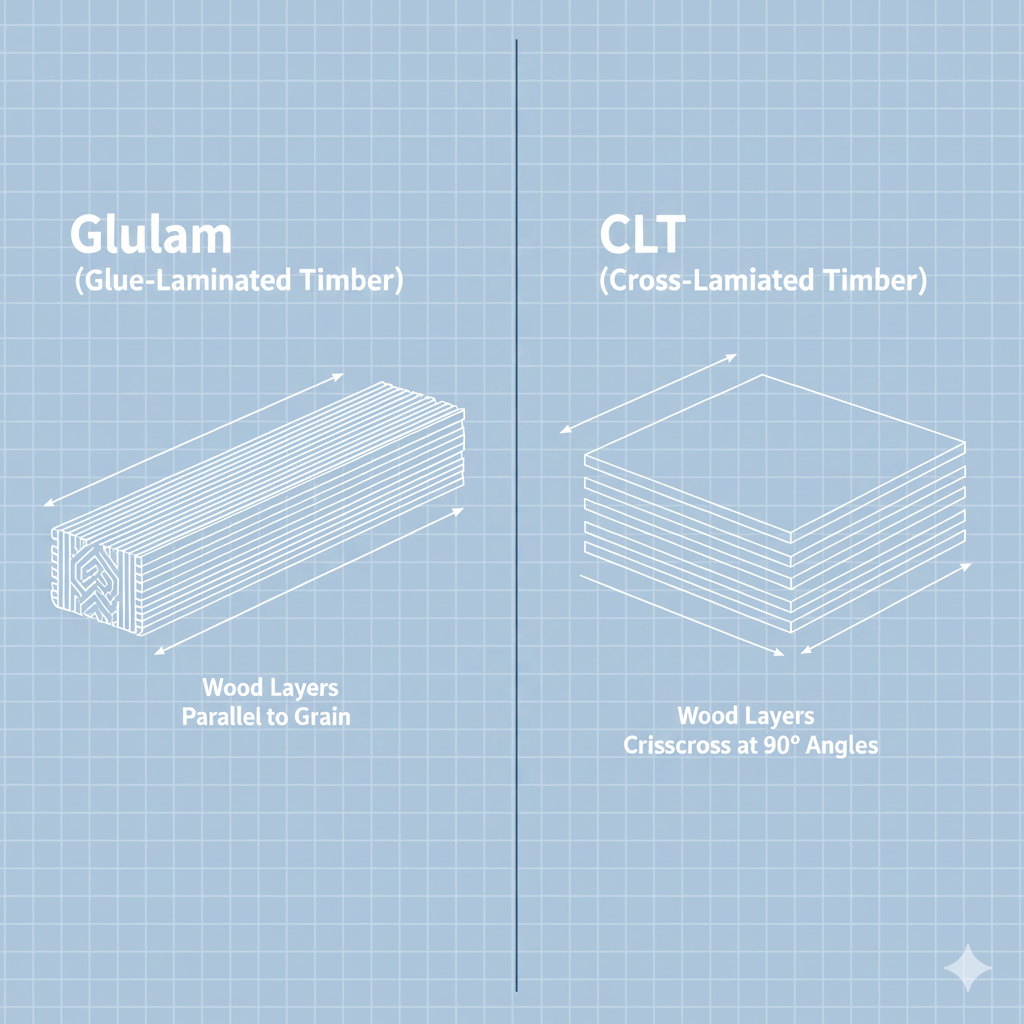
1. Cross-Laminated Timber (CLT)
Think of this as “Super Plywood.”
- The Build: Layers of lumber are stacked in alternating directions (90 degrees) and glued under immense pressure.
- The Strength: Because the grain runs in two directions, CLT panels have incredible dimensional stability. They don’t warp. They are used primarily for walls and floors.
- The Scale: A single panel can be 10 feet wide and 60 feet long, acting as a complete floor slab.
2. Glued Laminated Timber (Glulam)
- The Build: Layers of timber are stacked with the grain running parallel to the length.
- The Strength: This maximizes longitudinal strength, making it perfect for columns and beams.
- The Look: When you see those beautiful, swooping wooden arches in a modern library, that is Glulam.
3. Dowel-Laminated Timber (DLT)
- The Build: Similar to Glulam, but instead of glue, the wood is held together by hardwood dowels. The dowels expand, locking the timber in place.
- The Benefit: It is 100% wood. No glue, no chemicals. It is the purist’s choice for Mass Timber Construction.
The Sustainability Case: Buildings as Carbon Vaults
The primary driver behind Mass Timber Construction is the carbon equation.
The Concrete Problem
To make concrete, you heat limestone to 1,500°C. This chemical reaction releases massive amounts of CO2. Concrete is a “carbon emitter.”
The Timber Solution
Trees grow by inhaling CO2. They turn that carbon into wood fiber and release oxygen.
- Sequestering: When we harvest a tree and turn it into a Mass Timber beam, that carbon remains trapped inside the wood for the life of the building.
- The “Carbon Vault”: A 18-story wooden building essentially acts as a massive battery of stored carbon.
- Regrowth: If the timber is sourced from sustainably managed forests (FSC certified), young trees are planted immediately. Young trees absorb carbon faster than decaying old ones. It is a regenerative cycle.
Note: Research suggests that substituting timber for steel and concrete could reduce the construction industry’s emissions by 14% to 31%.
The Myth of Fire: “Won’t It Just Burn Down?”
This is the first question every client, mayor, and neighbor asks. “You want to build a high-rise out of kindling?”
The answer lies in the physics of large logs. If you try to light a massive log on a campfire with a single match, it won’t ignite. It’s too dense. Mass Timber Construction behaves the same way.
The Charring Effect
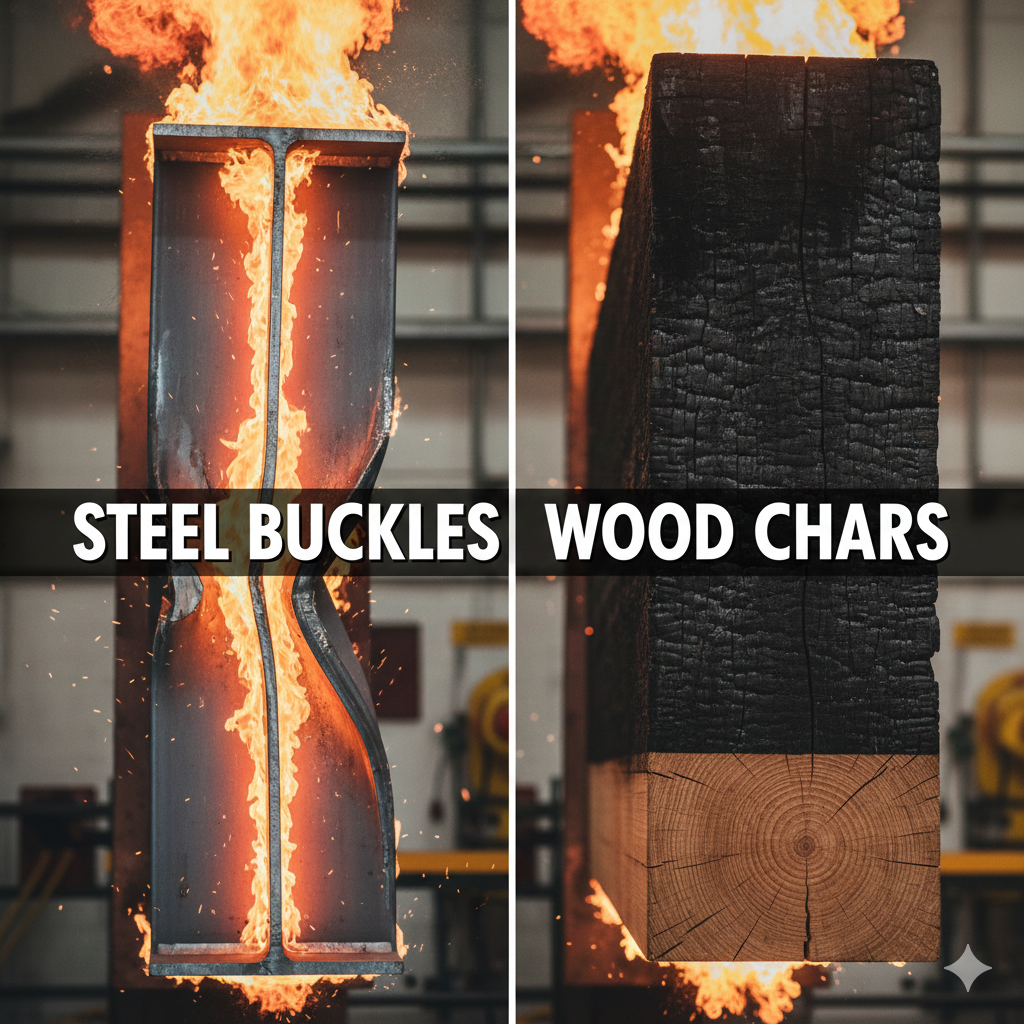
During a fire, the outer layer of Mass Timber chars. This black charcoal layer acts as a natural insulator, protecting the cool, structural wood core.
- Predictability: Engineers can calculate exactly how fast the wood chars (roughly 0.6mm per minute). They simply oversize the beam. If the code requires 2-hour fire resistance, they make the beam 2 inches thicker. The outer 2 inches act as the “sacrificial layer,” while the inner core holds the building up.
- Steel vs. Wood: In an intense fire, steel softens and buckles unpredictably (often leading to sudden collapse). Mass Timber stands firm until it burns through, which takes hours.
Speed and Efficiency: The LEGO Effect
Mass Timber Construction is a “Design for Manufacturing and Assembly” (DfMA) process.
- The Factory Phase: Every wall, floor, and beam is cut to millimeter precision in a factory using CNC robots. Window openings are cut, and holes for plumbing are pre-drilled.
- The Site Phase: The components arrive on trucks, numbered like a model kit. A small crew with a crane simply clicks them into place.
- The Result: Buildings go up 25% to 50% faster than concrete projects.
- No Curing Time: You don’t have to wait for concrete to dry.
- Quieter Sites: No jackhammers, no cement mixers. Just the hum of electric screwdrivers.
Case Study: The Brock Commons (Vancouver)
This 18-story student residence went up at lightning speed. The timber structure was completed in just 9.5 weeks. That is nearly two floors per week.
Biophilia: The Health Factor
We have discussed the planet and the schedule, but what about the human? Mass Timber Construction is the ultimate expression of Biophilic Design.
Humans have an innate evolutionary connection to wood. Studies show that being in a room with exposed timber surfaces:
- Lowers heart rate.
- Reduces stress levels (cortisol).
- Increases productivity.
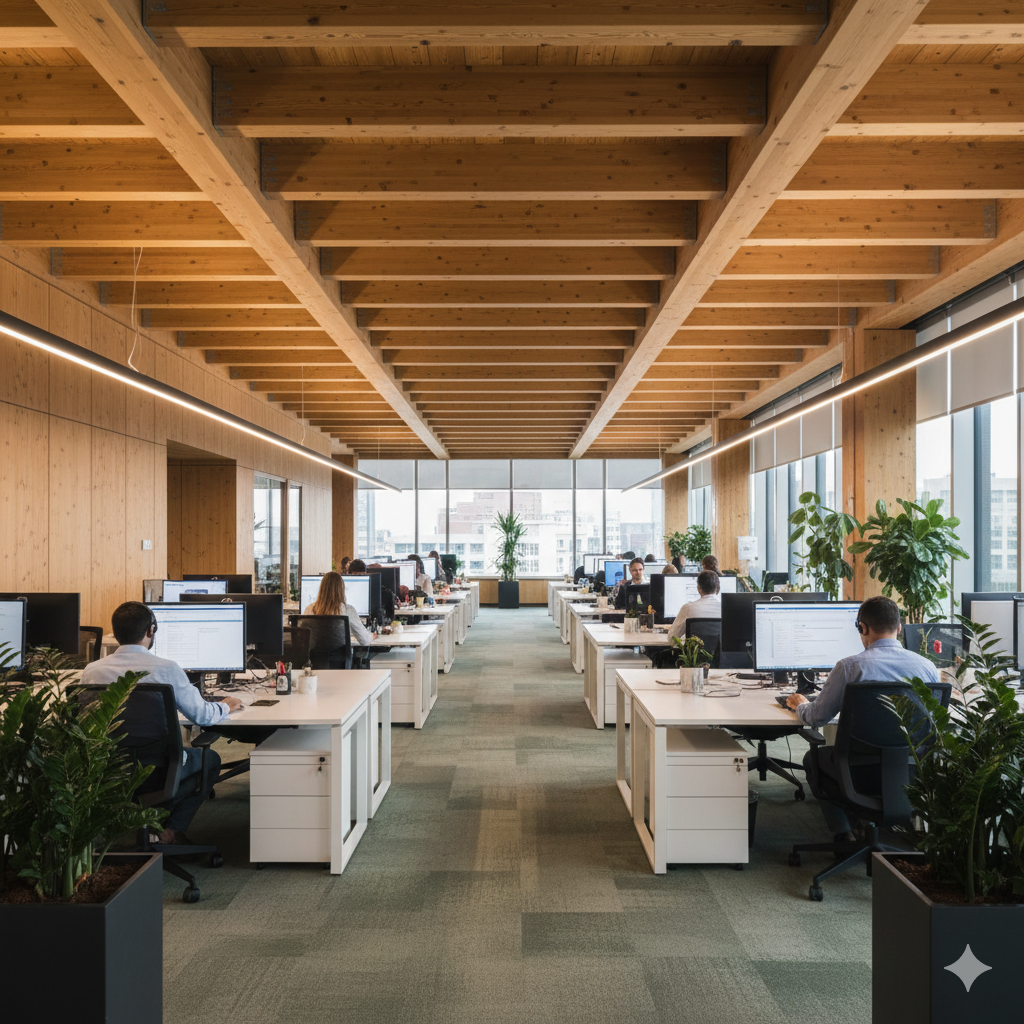
In a concrete office, you have to add plants to make it feel alive. In a Mass Timber office, the building is the plant. The smell, the texture, and the warmth of the wood create an environment that feels less like a factory and more like a forest.
The Skyscrapers of 2026: Case Studies
Mass Timber Construction is reaching new heights—literally.
1. Ascent MKE (Milwaukee, USA)
Standing at 284 feet (25 stories), Ascent is currently the world’s tallest timber-concrete hybrid building. It features luxury apartments with exposed timber ceilings. It proved that US building codes could adapt to tall wood.
2. Mjøstårnet (Norway)
A mixed-use tower overlooking a lake. It uses Glulam columns so massive they look like redwood trunks. It was a pioneer in proving that you can go tall without a concrete core.
3. The Academic Wood Tower (Toronto, Canada)
Set to be a landmark for the University of Toronto, this project (slated for 2026) pushes the boundaries of institutional design, proving that timber can handle the heavy foot traffic of a university.
The Challenges: It’s Not All Perfect
To be fair, Mass Timber Construction faces hurdles.
- Moisture Management: Wood hates water. During construction, if it rains on the exposed timber frame, it can cause staining or swelling. Contractors must be vigilant about tarping and sealing.
- Acoustics: Wood is light. It doesn’t block sound as well as heavy concrete. Mass timber floors often need a layer of concrete topping or acoustic mats to stop you from hearing your upstairs neighbor walking in heels.
- Supply Chain: While growing, there are fewer CLT factories than concrete plants. Shipping heavy timber panels across the country can eat into the carbon savings.
Conclusion
Mass Timber Construction is not a fad. It is a necessary correction. We spent the 20th century trying to conquer nature with steel; the 21st century will be defined by collaborating with nature using wood.
It offers a “triple threat” solution:
- Ecological: It stores carbon.
- Economic: It builds faster.
- Emotional: It feels better to live in.
As building codes continue to evolve and forests are managed more intelligently, the skyline of the future will not just be grey. It will be golden.
Frequently Asked Questions (FAQ)
Is Mass Timber construction more expensive than concrete?
Material-wise, Mass Timber can be 5-10% more expensive upfront. However, the total project cost is often similar or lower because the speed of construction reduces labor costs and loan interest payments significantly.
Does Mass Timber cause deforestation?
Not if sourced correctly. Mass Timber relies on sustainable forestry (like FSC or PEFC certified). This involves harvesting trees at maturity and replanting immediately. It often uses younger, smaller trees (thinnings) that need to be cleared anyway to prevent forest fires.
How tall can you build with wood?
The current limit is around 25-30 stories (like the Ascent in Milwaukee). However, engineers are exploring designs for up to 80 stories using hybrid systems (timber + steel core).
Is Mass Timber durable? Will it rot?
Like any material, it requires protection. As long as the wood is kept dry (cladded properly on the exterior and protected from plumbing leaks), it can last centuries. Some of the oldest temples in Japan are wood and have stood for 1,000+ years.
Can I see the wood inside the building?
Yes! That is one of the biggest perks. Fire codes often allow a significant percentage of the timber structure to remain exposed, eliminating the cost (and carbon) of adding drywall and paint.