


Table of Contents
In the world of construction, we are addicted to digging. We dig for limestone to make concrete; we drill for oil to make plastic insulation; we mine for ore to make steel. It is an extractive, destructive process that depletes the planet to build our cities.
But what if, instead of mining our materials, we could grow them?
This is not a utopian dream from a sci-fi novel. It is happening right now in laboratories and factories across the globe. The material is called Mycelium Composites, and it is poised to disrupt everything from packaging to architecture.
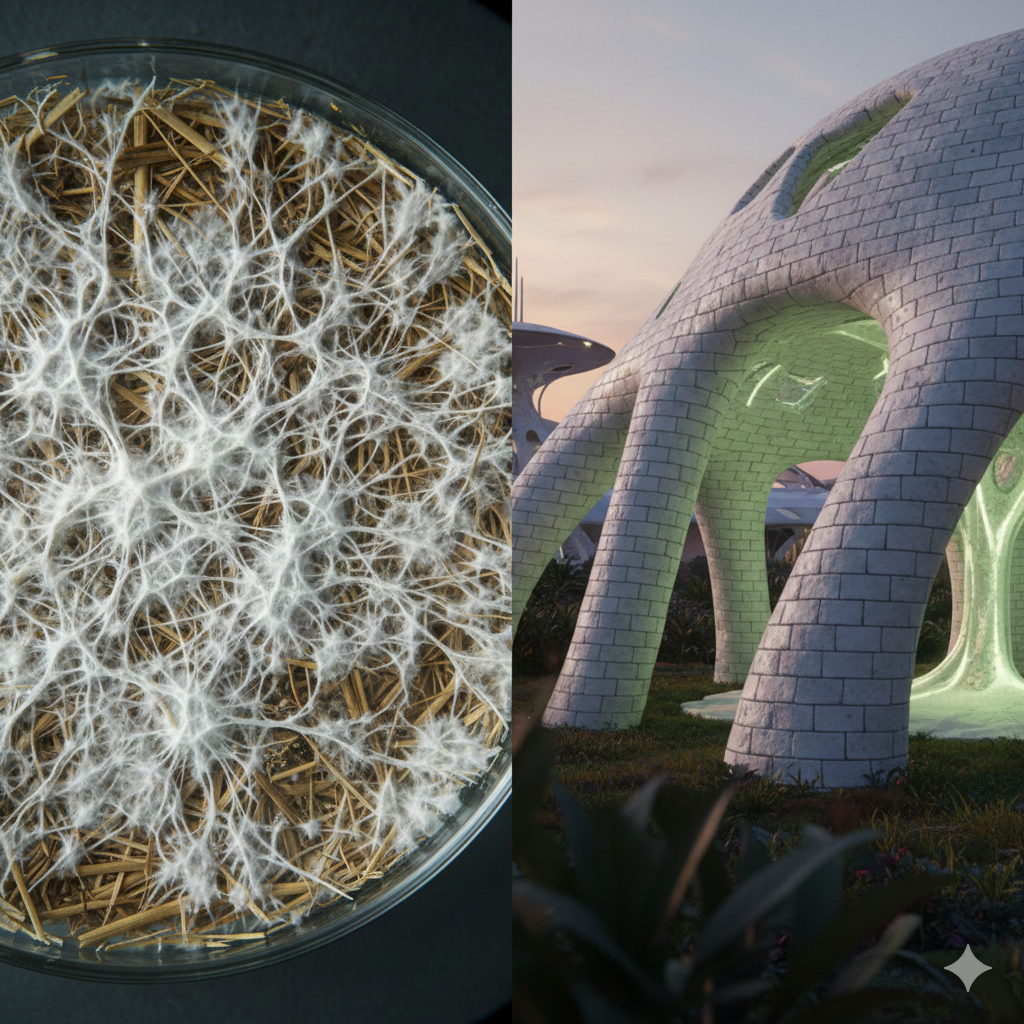
Mycelium is the root structure of fungi. It is the underground “internet” of the forest, a vast network of white threads that breaks down organic matter. When harnessed by engineers, this delicate web becomes a glue that is stronger, lighter, and more sustainable than almost anything we currently use.
In this deep dive, we will explore the science of fungal architecture, how Mycelium Composites are turning agricultural waste into fire-resistant bricks, and why your next home might literally be alive.
The Science: What Exactly is Mycelium?
To understand the material, you have to understand the organism. When you see a mushroom pop up on your lawn, you are only seeing the “fruit.” The real work is happening underground.
Mycelium is a vegetative part of a fungus, consisting of a mass of branching, thread-like hyphae. These hyphae are incredible binders. They act like a microscopic, self-assembling glue.+2
The Recipe for a Brick
Creating Mycelium Composites is surprisingly low-tech. It’s more like cooking than manufacturing.
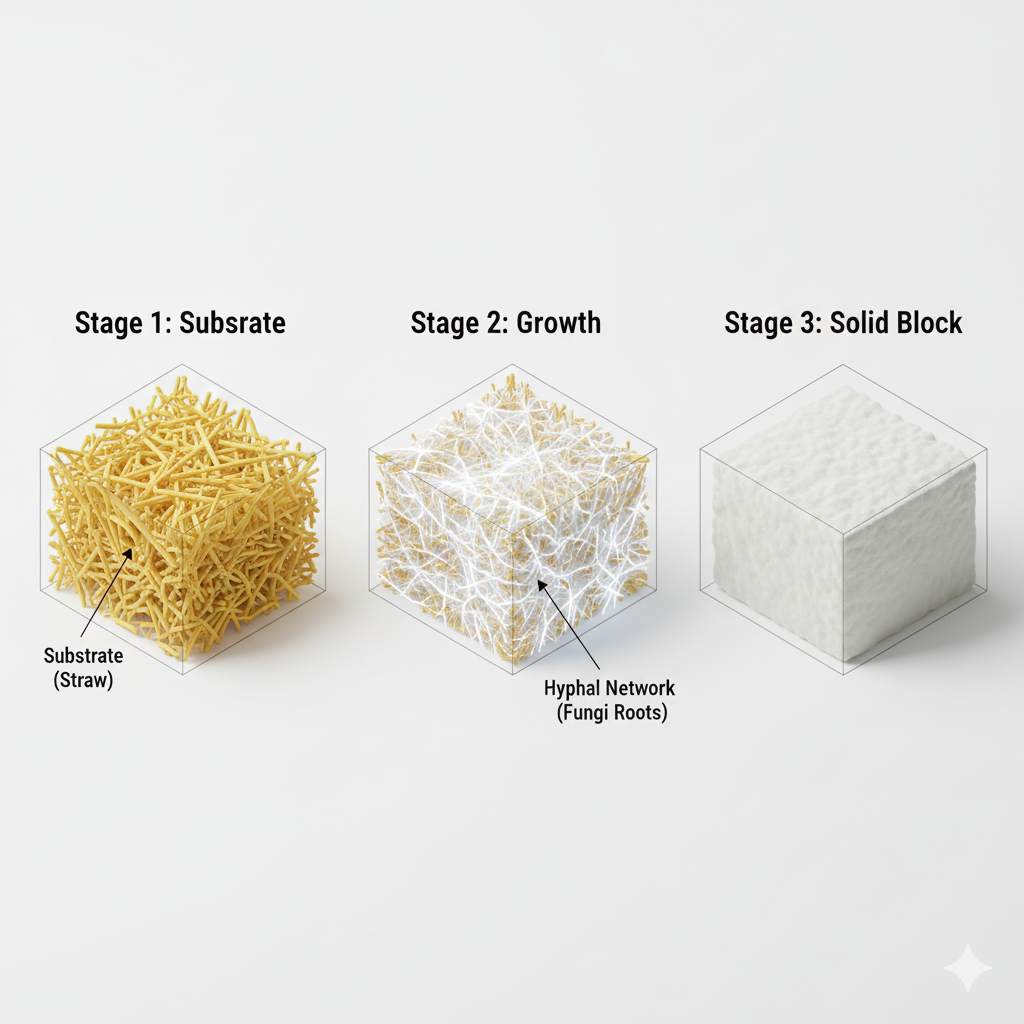
- The Substrate: You start with agricultural waste—corn stalks, hemp hurd, or straw. This is the “food.”
- The Inoculation: You introduce mushroom spores (often Reishi or Oyster mushrooms) to the substrate.
- The Growth: Over 5-7 days, the mycelium eats the waste. As it digests, it grows a dense network of white fibers that bind the loose straw into a solid, durable mass.
- The Bake: Once the material reaches the desired shape, it is heated. This kills the fungus (stopping the growth) and solidifies the brick.
The result? A material that is water-resistant, fire-resistant, and completely biodegradable.
Why Build with Mushrooms? The Super-Properties
Why would an architect choose fungus over foam? Mycelium Composites offer a suite of properties that synthetic materials struggle to match.
1. Fire Resistance
This is the big one. Most foam insulation is petroleum-based and highly flammable. Mycelium, however, is naturally self-extinguishing. It chars but does not melt or release toxic fumes. In a world increasingly prone to wildfires, this is a game-changer.
2. Acoustic Mastery
Mycelium is porous. This makes it an exceptional acoustic absorber. Acoustic panels made from mycelium can absorb up to 75% of sound at 1000Hz, making them perfect for noisy offices or restaurants.+1
3. Thermal Insulation
With an R-value of roughly R-3 per inch, mycelium boards are competitive with fiberglass and mineral wool. But unlike fiberglass, which requires high heat to produce and irritates the skin, mycelium is grown at room temperature and is safe to handle.
4. The Circular Economy Hero
When a Styrofoam block is discarded, it sits in a landfill for 500 years. When a block of Mycelium Composite is discarded, you can crumble it into your garden, and it will decompose into fertilizer in 60 days. It creates a truly circular lifecycle: from earth, to building, back to earth.
Real-World Applications: It’s Not Just Hype
Mycelium Composites are already out of the lab and into the market.
Packaging (The Styrofoam Killer)
Companies like Ecovative Design (the pioneers of this tech) have partnered with IKEA and Dell to replace polystyrene packaging. The “Mushroom Packaging” protects servers and furniture during shipping and can be tossed in the compost bin by the customer.
The Hy-Fi Tower
In 2014, The Living (an architectural studio) built the Hy-Fi Tower at MoMA PS1 in New York. It was a 40-foot tall tower made of 10,000 mycelium bricks. It stood for three months, withstood a hurricane, and when the exhibition was over, the entire tower was composted and used to fertilize local community gardens. It proved that Mycelium Composites could handle structural loads and outdoor elements.+1
Fashion and Furniture
Designers are growing lampshades, chairs, and tables. The material has a unique, velvety texture that feels like a cross between suede and cork. It brings a “softness” to interiors that concrete cannot provide.

Challenges: Why Aren’t We Living in Mushroom Houses Yet?
If it’s so great, why is concrete still king?
- Compressive Strength: Mycelium is strong for its weight, but it’s not concrete. A mycelium brick has a compressive strength of about 30 psi, whereas concrete is 4,000 psi. You cannot build a skyscraper foundation out of mushrooms (yet). Currently, it is best used for insulation, non-load-bearing walls, and cladding.
- Moisture Sensitivity: While water-resistant, it is still organic. If left exposed to constant rain without a coating, it can degrade or become a host for mold. It needs to be sealed or used in dry environments.
- Scale of Production: We have 100 years of infrastructure for pouring concrete. We are just starting to build the “farms” needed to grow buildings. Scaling up production to meet global demand is the current hurdle.
The Future: “Alive” Architecture
The most exciting part of Mycelium Composites is what comes next.
Researchers are experimenting with keeping the mycelium alive within the walls.
- Self-Healing: Imagine a wall that, when cracked, simply grows back together.
- Air Filtering: Living walls that actively digest toxins and scrub CO2 from the air inside your home.
We are moving toward an era of Bio-Architecture, where our buildings are not dead statues, but living organisms that participate in the ecosystem.

Conclusion
Mycelium Composites challenge the very definition of “technology.” We often think high-tech means shiny metal and silicon. But nature has been refining its technology for 3.8 billion years.
By partnering with fungi, we are unlocking a way to build that is regenerative rather than extractive. We are learning that the strongest structures aren’t necessarily the hardest—they are the most adaptable.
The mushroom might be humble, but it just might be the heavyweight champion of the sustainable future.
Frequently Asked Questions (FAQ)
Will a mycelium house smell like mushrooms?
No. Once the material is dried and heat-treated, it is odorless. It smells faintly of toasted bread or wood during the drying process, but the final product is neutral.
Can I get allergies from mycelium walls?
No. The manufacturing process involves heat-killing the fungus. There are no active spores released into the air. It is actually hypoallergenic compared to synthetic insulations that release VOCs.
Is it expensive?
Currently, it is a premium product compared to cheap Styrofoam or fiberglass because production scale is low. However, the raw materials (farm waste) are dirt cheap. As production scales up, prices are expected to drop below synthetic alternatives.
Will it rot or attract pests?
No. The heat treatment renders the mycelium inert. It is no longer “food” for insects or mold. It is as stable as dried wood. However, like wood, it should be kept dry to prevent rot over decades.
Where can I buy mycelium insulation?
Companies like Ecovative and Mogu (in Europe) are the main suppliers. It is becoming more available for architectural specification, though it is not yet a standard item at your local hardware store.

