Table of Contents
For centuries, architects have spoken a language that their clients do not understand. We speak in elevations, sections, and floor plans—2D abstractions of a 3D world. We ask clients to stare at a flat piece of paper and “imagine” the volume of a cathedral ceiling or the play of light in a breakfast nook. It is an imperfect translation, and often, the message gets lost.
But in 2025, the translation gap is closing. AR & VR in Architecture has moved beyond the realm of video games and novelty tech demos to become the standard for design communication. We are witnessing the death of the blueprint and the rise of the “Experience.”
AR & VR in Architecture is not just about fancy visuals; it is a fundamental shift in how we conceive, communicate, and construct space. It allows us to inhabit a building before the first brick is laid. It allows a contractor to see pipes inside a wall before they drill. It allows a client in Tokyo to walk through a penthouse in New York without leaving their office.
In this ultimate guide, we will explore the nuances of this technology, the hardware revolution (hello, Apple Vision Pro), and how you can leverage AR & VR in Architecture to win more work, reduce errors, and design with unprecedented clarity.
Defining the Reality Spectrum: VR, AR, and MR
To master AR & VR in Architecture, we must first clarify the terminology. These acronyms are often thrown around loosely, but they represent distinct tools in the architect’s arsenal.
1. Virtual Reality (VR): The Teleporter
VR is total immersion. You put on a headset (like the Meta Quest 3 or HTC Vive), and the real world disappears. You are transported entirely inside the digital model.
- Best for: Design development, client presentations, and understanding scale. In VR, you don’t just see the room; you feel the room. You understand if a hallway feels too narrow or if a ceiling feels oppressively low.
2. Augmented Reality (AR): The Overlay
AR keeps you in the real world but overlays digital information onto it via a tablet, smartphone, or smart glasses.
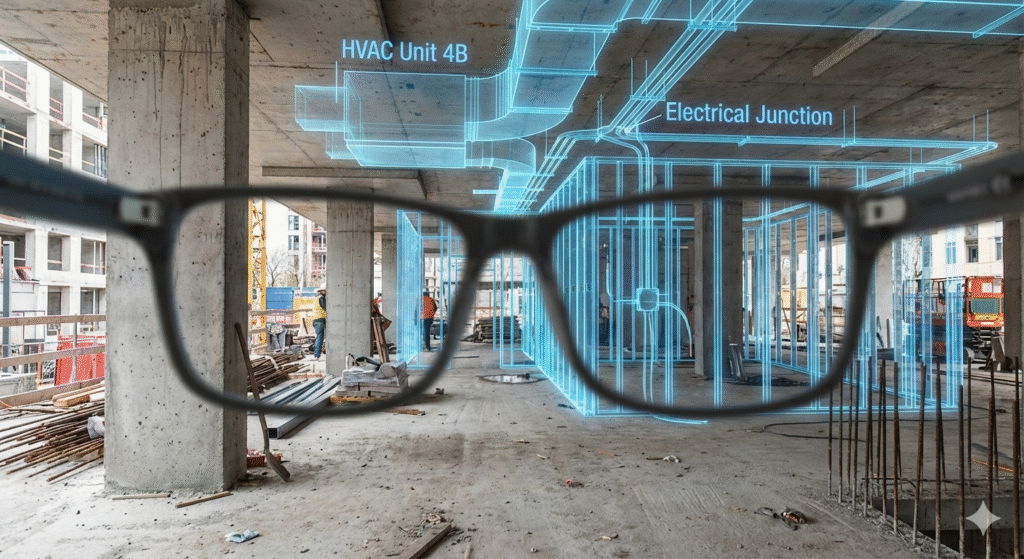
- Best for: Construction sites and renovation projects. Imagine holding an iPad up to an empty construction site and seeing the finished building superimposed on the dirt. Or holding it up to a wall and seeing the BIM model of the plumbing behind it.
3. Mixed Reality (MR): The Hybrid
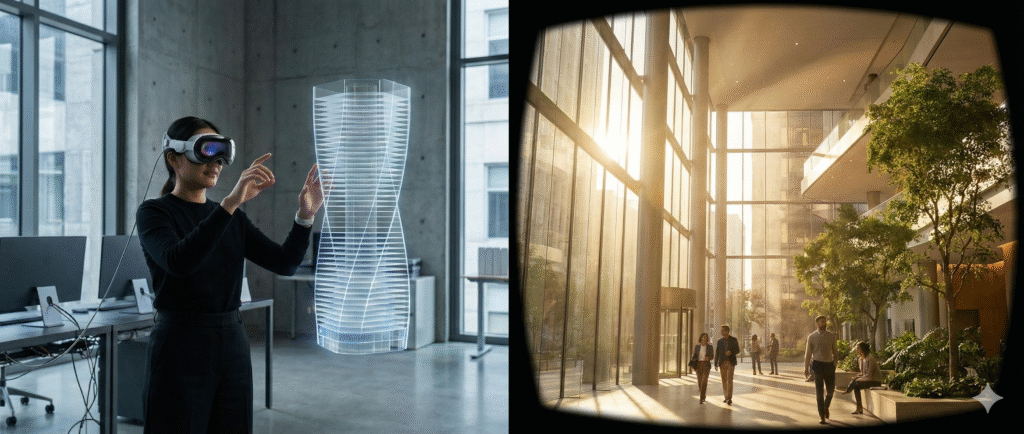
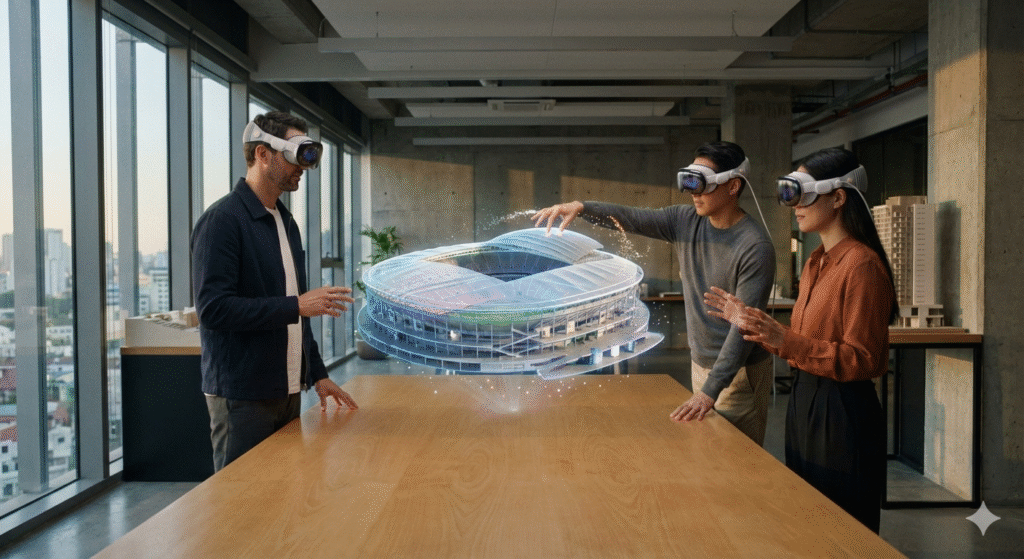
MR is the cutting edge, popularized by devices like the Apple Vision Pro and Microsoft HoloLens. It anchors virtual objects into the real world. You can place a virtual architectural model on your physical conference table, walk around it, and interact with it as if it were a physical clay model.
The integration of AR & VR in Architecture is about choosing the right tool for the right phase of the project. VR is for the dream; AR is for the reality.
VR in Architecture: The Design Revolution
The primary application of AR & VR in Architecture begins in the studio. Traditionally, architects designed in 2D and occasionally extruded to 3D. Today, we can design inside the simulation.
The “Scale” Problem Solved
The hardest thing for a junior architect to learn is scale. How wide is 1.5 meters, really? In 2D CAD, it’s just a number. In AR & VR in Architecture, it is a physical experience. By designing in VR, architects can spot ergonomic issues immediately. “I can’t reach that shelf,” or “This door swings into the view.” These are errors that used to cost thousands of dollars to fix on-site. Now, they are fixed with a click of a mouse.
The Emotional Client Pitch
Clients don’t buy floor plans; they buy feelings. AR & VR in Architecture is the ultimate sales tool because it bypasses the intellectual brain and hits the emotional brain. When a client puts on a headset and stands on the virtual balcony of their future home, hearing the simulated wind and seeing the sunset over the specific site topography, the sale is closed. They aren’t imagining the house; they are remembering it.
Software Leaders in VR:
- Enscape: The industry favorite for instant VR. It plugs directly into Revit, SketchUp, and Rhino. One click, and you are in.
- Twinmotion / Unreal Engine: For high-fidelity, photorealistic rendering. This is where you go when you want the lighting, textures, and physics to be indistinguishable from reality.
AR in Architecture: The Construction Site Superpower
If VR is for the office, AR is for the field. The application of AR & VR in Architecture on the job site is arguably where the most money is saved.
The “X-Ray Vision” Effect
Construction errors often happen because of a disconnect between the complex 3D coordination model (BIM) and the physical site. AR bridges this gap. Using tools like Gamma AR or VisualLive, a site manager can walk the floor with a tablet. The tablet tracks their location and overlays the BIM model on the camera feed. They can verify that the ventilation duct is being installed at the exact height specified in the model. If it’s off by an inch, they catch it before the ceiling is closed up.
Remote Inspection and Collaboration
With AR & VR in Architecture, the lead architect doesn’t need to fly to the site every week. A site foreman wearing a HoloLens or smart glasses can “stream” their view to the architect’s office. The architect can draw circles in the air that appear in the foreman’s field of view, pointing out specific details or defects. “Move this outlet here,” they might say, circling a spot on the virtual wall.
The Hardware: The Toys of the Trade in 2025
To implement AR & VR in Architecture, you need hardware. The landscape has changed drastically in the last two years.
1. The Apple Vision Pro (and its successors)
Apple’s entry into the market legitimized “Spatial Computing.” For architects, the high resolution of the Vision Pro means you can read the text on a virtual blueprint. Its ability to seamlessly blend the room you are in with the model you are designing makes it the ultimate Mixed Reality tool.
2. Meta Quest 3
The workhorse. It is affordable, wireless, and powerful enough to run standalone VR walkthroughs. For sending a headset to a client so they can view the design at home, this is the standard.
3. Microsoft HoloLens 2 / Trimble XR10
Still the king of the construction site. The Trimble XR10 is essentially a HoloLens integrated into a certified hard hat. It is rugged, hands-free, and designed specifically for overlaying BIM models in dangerous environments.
The Gamification of Architecture
A fascinating trend within AR & VR in Architecture is the crossover with the gaming industry. Architects are now hiring game developers. Why?
Because game engines like Unreal Engine 5 and Unity are capable of handling massive datasets and real-time lighting (Ray Tracing) better than traditional CAD software.
- Interactivity: In a game engine, you can program logic. You can let the client open doors, turn on lights, change the flooring material instantly, or even simulate a fire evacuation to test safety routes.
- The Metaverse: As virtual real estate becomes a commodity, architects are designing buildings that will never exist physically. These “crypto-architects” use AR & VR in Architecture to build virtual HQs for companies in the Metaverse.

Overcoming the Barriers to Entry
If AR & VR in Architecture is so great, why isn’t every firm using it?
- Cost: High-end headsets and the PCs required to run them are expensive. However, compared to the cost of a single construction error (which can be tens of thousands of dollars), the ROI is almost immediate.
- Motion Sickness: This used to be a major issue. However, modern headsets with higher refresh rates (90Hz or 120Hz) and 6-Degrees-of-Freedom (6DoF) tracking have largely solved this for most users.
- The “Gimmick” Perception: Some older partners still view VR as a toy. The key to overcoming this is to demonstrate utility. Don’t just show a pretty picture; show how VR revealed a clash between a beam and a window that 2D drawings missed.
Conclusion: The End of the Abstract
We are living through the end of the era of abstraction. For 5,000 years, architects have had to mentally reconstruct 3D worlds from 2D lines. That cognitive load is now gone.
AR & VR in Architecture liberates the designer and the client. It democratizes design, making it accessible to those who cannot read blueprints. It brings transparency to construction, shining a light on the hidden systems of our buildings.
As we look toward the future, the question is not if you will use AR & VR in Architecture, but how. Will you use it to tell a better story? Will you use it to build a safer site? Or will you be left behind, clutching a roll of paper drawings while the world builds in holograms?
The virtual world is open. Step inside.

Frequently Asked Questions (FAQ)
What is the difference between AR and VR in architecture?
VR (Virtual Reality) fully immerses you in a digital environment, blocking out the real world—perfect for design walkthroughs. AR (Augmented Reality) overlays digital elements onto the real world—perfect for on-site construction checks.
Do I need a powerful computer for AR & VR in Architecture?
For high-end VR (tethered headsets like Varjo or HTC Vive), yes, you need a PC with a powerful graphics card (GPU). However, standalone headsets like the Meta Quest 3 can run lighter architectural models without a PC. AR apps on iPad Pro use the tablet’s internal processor.
Is VR difficult to learn for architects?
Not anymore. Plugins like Enscape and Twinmotion have made it “one-click” simple. If you can model in Revit or SketchUp, you can use VR.
Can AR & VR really save money on construction projects?
Yes. By detecting “clashes” (e.g., a pipe hitting a beam) in the virtual model before construction begins, firms save thousands on rework. AR on-site prevents installation errors by giving workers a digital guide.
What is the best headset for architects in 2025?
It depends on the budget. The Apple Vision Pro offers the best visual fidelity and Mixed Reality features. The Meta Quest 3 offers the best value and ease of use. The Trimble XR10 (HoloLens 2) is the best for rugged construction site usage.