


Table of Contents
The construction industry is infamous for a single, pervasive inefficiency: the “handover gap.” For decades, architects and engineers have poured thousands of hours into designing and building a structure, only to hand over a set of flat, static PDF drawings or rolls of paper to the facility manager upon completion. It is akin to buying a Tesla but receiving the user manual for a 1990s tractor.
The building is finished, but the data—the intelligence of the structure—dies the moment the ribbon is cut.
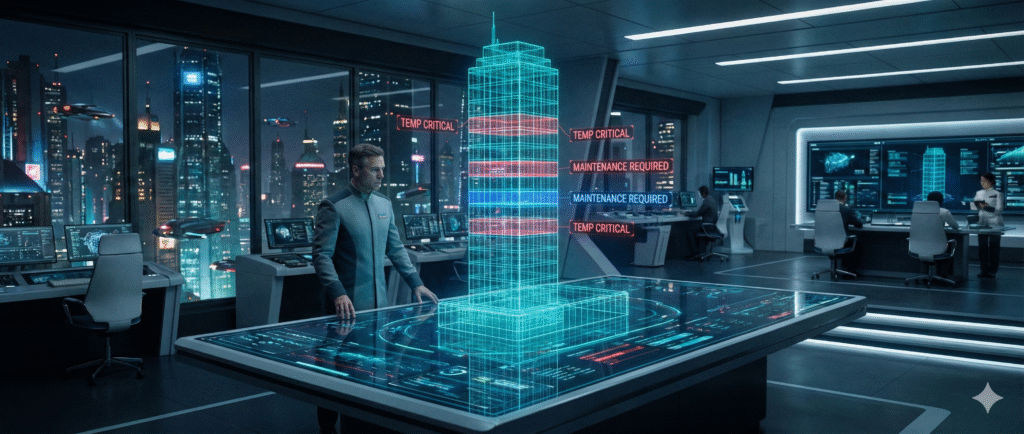
Enter BIM 7D. This is not just another layer of geometry; it is the integration of intelligence into the very fabric of our built environment. While 3D BIM gave us width, height, and depth, and 4D and 5D gave us time and cost, BIM 7D gives a building a brain. It creates a bridge between the construction phase and the operational phase, ensuring that the data generated during design lives on to inform the maintenance, sustainability, and efficiency of the building for decades to come.
In this comprehensive guide, we will dismantle the complexity of BIM 7D, explore its critical role in the future of facility management, and look at how it is already transforming iconic structures like the Sydney Opera House.
Understanding the Dimensions: Where Does 7D Fit?
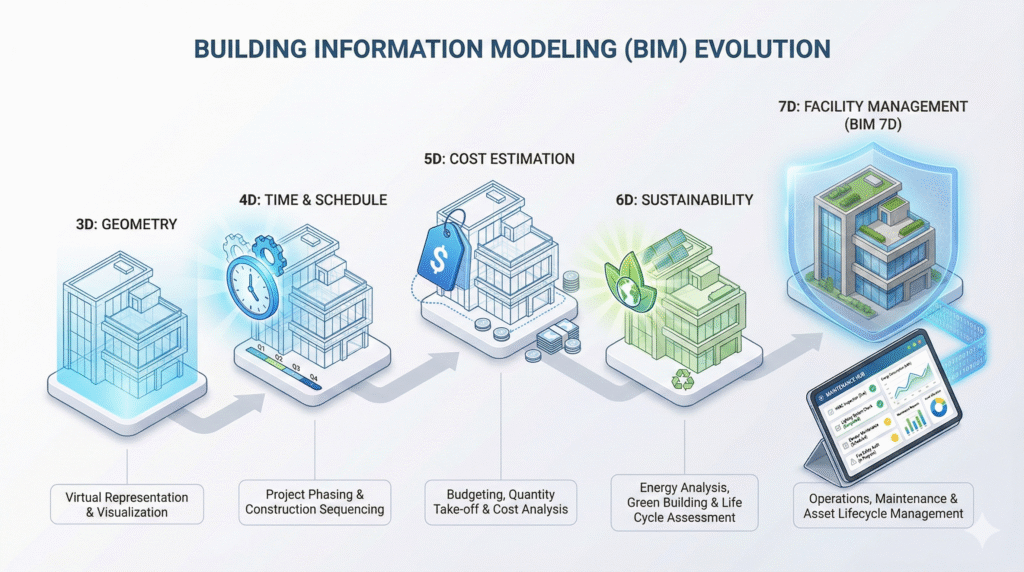
To appreciate the revolution of BIM 7D, we must first contextualize it within the evolution of Building Information Modeling (BIM). The industry has moved rapidly from simple geometry to complex data ecosystems.
- 3D BIM (Geometry): The visualization of the building in three-dimensional space.
- 4D BIM (Time): The integration of the construction schedule, allowing teams to visualize the build sequence.
- 5D BIM (Cost): The overlay of budget and cost estimation, tracking expenses in real-time as the design changes.
- 6D BIM (Sustainability): The analysis of energy consumption and environmental impact.
7D BIM is the dimension of Facility Management and Operations. It is the “As-Built” information model that serves as a database for the building’s entire lifecycle. It contains data on warranties, technical specifications, maintenance manuals, and manufacturer information for every single component in the building—from the HVAC chillers on the roof to the lightbulbs in the basement.
The Core Promise of BIM 7D: Closing the Loop
Why is this dimension so critical? Research suggests that 80% of a building’s total lifecycle cost is incurred during the operational phase (running, maintaining, and repairing it), while only 20% is spent on design and construction. Yet, historically, the industry has focused 90% of its technology and innovation on that first 20%.
BIM 7D flips this script. It targets the massive 80% of operational costs.
When a facility manager uses BIM 7D, they don’t just see a wall; they see a data object. By clicking on a virtual air conditioning unit in the model, they can instantly access:
- The installation date.
- The expected lifespan.
- The exact model number for spare parts.
- The warranty expiration date.
- The maintenance log of who serviced it last.
This eliminates the “forensic facility management” that plagues most buildings, where managers have to climb into ceiling cavities just to find a serial number.
Real-World Application: The Sydney Opera House
This is not theoretical. One of the most famous buildings in the world, the Sydney Opera House, has adopted a form of BIM 7D to manage its complex structure.
The Opera House is an engineering marvel, but maintaining it is a nightmare. It has concealed air intakes, seawater cooling systems, and massive concrete sails that require constant monitoring. The management team embarked on a journey to digitize the facility, moving away from 2D drawings to a rich, data-filled BIM model.
By implementing a BIM 7D strategy, the facility management team gained an “X-ray vision” of the building. They can now locate valves and ducts that are buried inside concrete walls without drilling exploratory holes. They can simulate maintenance scenarios before a technician even arrives on site. This transition has turned a heritage icon into a benchmark for modern digital asset management.

The Three Pillars of BIM 7D Success
Implementing BIM 7D successfully relies on three distinct pillars. Without one, the system collapses into just another 3D model.
1. Data Richness (LOD 500)
In BIM terms, “Level of Development” (LOD) defines how detailed a model is. BIM 7D requires LOD 500—the “As-Built” level. This means the digital model must match the physical reality exactly. If a pipe was moved 6 inches during construction to avoid a beam, the model must reflect that. If the model is inaccurate, the trust in the system evaporates.
2. Interoperability
A BIM 7D model cannot live on an architect’s supercomputer. It must be accessible on the facility manager’s iPad. This requires software interoperability (often using the COBie standard—Construction Operations Building Information Exchange) that allows data to flow from complex design software like Revit into manageable Facility Management (FM) systems like IBM Maximo or Archibus.
3. The “Digital Twin” Connection
The ultimate evolution of BIM 7D is the Digital Twin. While BIM is often a static database, a Digital Twin is dynamic. By connecting the BIM 7D model to IoT (Internet of Things) sensors, the building comes alive.
- BIM 7D says: “This room should be maintained at 22°C.”
- The Digital Twin says: “This room is currently 26°C, and the AC unit is vibrating abnormally.”
Benefits: Why Owners Are Demanding It
The demand for BIM 7D is increasingly coming from the clients—the building owners—rather than the architects. They are realizing that paying for a BIM model during construction and then throwing it away is a waste of capital.
Streamlined Maintenance
Reactive maintenance is expensive. Waiting for a pipe to burst costs 10x more than replacing a washer on a schedule. BIM 7D enables Preventive Maintenance. The system can alert managers: “Component X has run for 10,000 hours; please schedule service.”
Energy Efficiency & Sustainability
You cannot optimize what you cannot measure. With a detailed inventory of every energy-consuming asset linked to its spatial location, managers can identify heat leaks, inefficient layouts, and equipment that is drawing too much power. This is crucial for meeting modern Net Zero targets.
Disaster Response
In the event of a fire or leak, BIM 7D provides first responders with critical information instantly. They can see exactly where hazardous materials are stored or where the shut-off valves are located on a tablet before they even enter the building.

Challenges to Mass Adoption
If BIM 7D is so powerful, why isn’t every building using it?
- The Data Deluge: A 7D model contains millions of data points. Managing this volume of information requires specialized skills that many facility management teams currently lack.
- Software Fragmentation: The construction industry is notorious for using different software that doesn’t talk to each other. Exporting data from a design tool to an FM tool is getting better, but it is still often a clunky process.
- Cost of Implementation: Creating an LOD 500 model takes time and money. Developers looking for a quick exit might not want to pay for a model that only benefits the future owner.


Conclusion
BIM 7D is more than a buzzword; it is the inevitable maturity of the construction industry. We are moving from an industry of “brick and mortar” to an industry of “data and sensors.”
For architects, engineers, and contractors, the message is clear: your job is no longer just to erect a building. Your job is to create a comprehensive digital asset that will serve the owner for fifty years. The buildings of the future will not just be defined by their skyline silhouette, but by the intelligence of their digital twin.
The revolution is here. The question is, are you building for the handover, or are you building for the lifecycle?
FAQ
-
What is the main difference between BIM 6D and BIM 7D?
BIM 6D focuses on Sustainability (energy analysis, green targets), whereas BIM 7D focuses on Facility Management (maintenance schedules, asset data, warranty information).
-
Can BIM 7D be applied to existing buildings?
Yes, this process is called “Retro-BIM.” It involves laser-scanning an existing building to create a 3D model and then manually populating it with asset data. It is expensive but highly valuable for complex heritage buildings like the Sydney Opera House.
-
What software is used for BIM 7D?
Common tools include Autodesk Revit (for creating the model), Archibus, IBM Maximo, and EcoDomus (specifically for bridging BIM data into facility management).
-
Does BIM 7D really save money?
Yes. While the upfront cost of creating the model is higher, it drastically reduces the “Lifecycle Cost” of the building—which accounts for 80% of the total money spent on a building over its life—by optimizing maintenance and energy use.
-
Who is responsible for creating the BIM 7D model?
Typically, the responsibility falls on the General Contractor or the Architect to deliver the “As-Built” model at the end of construction. However, the requirements must be specified by the Building Owner in the contract (often in a document called the EIR – Employer’s Information Requirements).
![Architecture A to Z [Guide to Popular Concepts]](https://archovavisuals.com/wp-content/uploads/2023/09/image-2.png)
