Table of Contents
The headlines are becoming impossible to ignore: record-breaking heatwaves scorching cities, “100-year floods” happening every few years, and superstorms battering our coastlines with increasing fury. Our climate is changing, and the built environment is on the front lines. The traditional approach to design—building for a predictable, stable climate—is no longer viable. We are in a new era that demands a new kind of building: one that doesn’t just exist in its environment, but actively responds and adapts to it.
This is the domain of climate-resilient architecture. It’s a proactive, forward-thinking approach that goes beyond simply being “green.” It’s about designing and constructing buildings that can withstand the shocks and stresses of a volatile climate, ensuring the safety, health, and well-being of their occupants during and after extreme weather events. This isn’t just a trend for high-end projects; it’s rapidly becoming the baseline standard for responsible construction. This guide will explore the top strategies you need to know to design and build for a resilient future.
More Than Green: What Defines Climate-Resilient Architecture?
For years, the conversation has been dominated by sustainable building design, which focuses on mitigation—reducing a building’s carbon footprint through energy efficiency, sustainable materials, and renewable energy. This is critically important work.
However, climate-resilient architecture focuses on adaptation. It accepts the reality that climate change is already happening and asks a crucial question: “How can this building survive and protect its inhabitants from heatwaves, floods, high winds, and wildfires, even if the power goes out?”
It’s about creating future-proof buildings that are durable, adaptable, and self-sufficient. The ultimate goal is to achieve passive survivability, a state where a building remains a safe and habitable shelter for a prolonged period without any external power, water, or fuel. This is the new benchmark for safety and security in the 21st century.


The Pillars of Resilience: Core Design & Build Strategies
Achieving true climate resilience requires a holistic approach that integrates site, structure, and systems. Let’s break down the essential strategies that form the foundation of climate-resilient architecture.
Strategy 1: Passive Survivability – The Art of Self-Reliance
When the grid fails during a blistering heatwave or a winter storm, a building’s design is all that stands between comfort and crisis. Passive survivability is the cornerstone of resilience, using the building’s own form and materials to maintain safe temperatures without mechanical systems.
- Natural Cooling and Ventilation: Before even thinking about an AC unit, architects should maximize natural airflow. This includes:
- Cross-ventilation: Orienting windows and doors to capture prevailing breezes and allow air to flow through the building.
- The Stack Effect: Using high, operable windows (clerestories) or solar chimneys to allow hot air to rise and escape, drawing cooler air in from below.
- Strategic Shading: Preventing the sun from overheating the building in the first place is the most effective cooling strategy. This can be achieved with properly sized roof overhangs, exterior louvers, awnings, and even strategically planted deciduous trees that provide shade in summer but allow sun in winter.
- Airtightness and Super-Insulation: The building envelope is your first line of defense. High-performance insulation in the walls, roof, and foundation, combined with an airtight seal, keeps heat out in the summer and in during the winter. This drastically reduces reliance on mechanical systems and keeps the interior stable for days during a power outage.
These passive strategies are fundamental to climate-resilient architecture because they work without power, ensuring a baseline of safety for occupants.

Strategy 2: Mastering Water – From Deluge to Drought
Climate change is amplifying the water cycle, leading to more intense rainfall and longer, more severe droughts. Climate-resilient architecture must be designed to handle both extremes.
For a World of Floods:
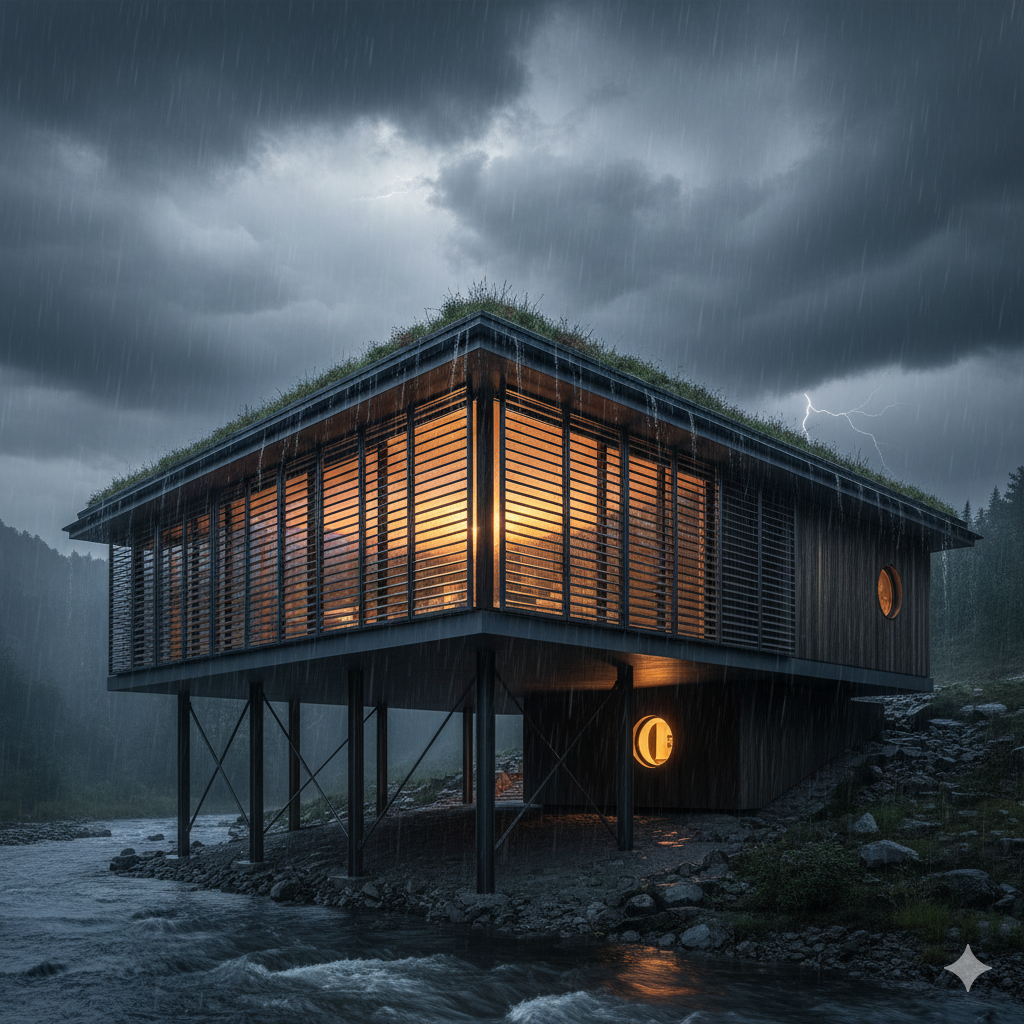
- Elevation is Key: The simplest and most effective strategy in flood-prone areas is to raise the building’s primary living spaces above the projected flood level (Base Flood Elevation, or BFE). This can be done on stilts, piers, or a raised foundation.
- The Wet-Proof Ground Floor: Design lower levels to be “sacrificial” spaces that can tolerate flooding. Use durable, water-resistant, and easily cleanable resilient building materials like polished concrete floors, concrete block walls, and marine-grade plywood. All electrical outlets and equipment should be elevated.
- Green Infrastructure: Instead of impermeable concrete that funnels water away, use permeable pavements, rain gardens, and bioswales. These nature-based solutions absorb and filter rainwater on-site, reducing the load on storm drains and recharging groundwater.
For a World of Drought:
- Harvest and Recycle: Install robust rainwater harvesting systems to capture water from the roof for irrigation and non-potable uses. Advanced greywater systems can recycle water from showers and sinks to flush toilets and water the landscape.
- Xeriscaping: Replace thirsty lawns with drought-tolerant, native plants that require minimal irrigation once established. This not only saves water but also creates a more resilient local ecosystem.
Strategy 3: Building a Fortress – Structural Integrity & Resilient Materials
As storms and wildfires become more intense, the structural system and material choices of a building are tested like never before. An extreme weather design philosophy is critical.
- Continuous Load Path: For high-wind areas, engineers must design a continuous load path that securely connects the roof to the walls and the walls to the foundation. This prevents the roof from being lifted off during a hurricane or tornado. Hurricane straps, reinforced connections, and impact-resistant windows and doors are non-negotiable.
- Fire-Resistant Design: In wildfire-prone regions (the Wildland-Urban Interface), the focus is on creating a defensible space and a non-combustible building. This means using resilient building materials like fiber-cement siding, metal roofing, and tempered glass windows. Designing with minimal eaves and vents that resist ember intrusion is also crucial.
- Durability Above All: The choice of materials should prioritize long-term durability and low maintenance. Materials that won’t rot, corrode, or degrade when exposed to moisture and sun will perform better over the long term and require fewer resource-intensive replacements. The core of climate-resilient architecture is longevity.
Strategy 4: Energy Independence and Redundancy
A resilient building should not be entirely dependent on a fragile, centralized power grid. On-site energy generation and storage are becoming essential components of climate-resilient architecture.
- Solar + Storage: Photovoltaic (PV) panels combined with a battery storage system create a powerful microgrid for the home. This provides electricity for critical loads—like a refrigerator, lights, and medical devices—during a blackout.
- Grid-Interactive Buildings: Smart systems can allow a building to not only draw from the grid but also provide power back to it, helping to stabilize the grid for the entire community during periods of high demand.
- Redundant Systems: For critical facilities like hospitals or community shelters, having multiple backup systems (e.g., batteries and a backup generator) is essential for ensuring continuous operation.
The First Step: Resilient Site Selection
The most important decisions in climate-resilient architecture are made before any design work begins. Thorough site analysis is paramount. This involves:
- Looking at Future Data: Don’t rely on historical weather data. Use climate projection models to understand the future risks for a specific location—sea-level rise, increased wildfire risk, higher average temperatures, and changing rainfall patterns.
- Avoiding High-Risk Zones: Whenever possible, avoid building in known high-risk areas like floodplains, coastal erosion zones, or areas with a high wildfire hazard rating.
- Working with Nature: A resilient site design sees the natural landscape as an asset. Preserving or restoring natural features like wetlands, dunes, and forests can provide powerful, free protection against storm surge and flooding.
Conclusion: Building for Tomorrow, Today
The shift towards climate-resilient architecture is not a matter of choice; it is an imperative driven by the physical realities of our changing world. It’s an investment in safety, a commitment to long-term value, and a responsibility we have to future generations.
By integrating strategies like passive survivability, smart water management, robust structural design, and energy independence, we can create buildings that are more than just shelters. We can create safe havens, community anchors, and future-proof buildings that are prepared to face the challenges ahead. The blueprints of today must be drawn for the world of tomorrow.
What is the main difference between green/sustainable architecture and climate-resilient architecture?
Green/Sustainable Architecture primarily focuses on mitigation—reducing the environmental impact of a building (e.g., lowering carbon emissions, using renewable materials). Climate-Resilient Architecture focuses on adaptation—ensuring the building can withstand and function during the impacts of climate change that are already happening (e.g., floods, heatwaves). Ideally, a building should be both sustainable and resilient.
Does building a climate-resilient home cost more?
There can be a higher upfront cost, sometimes estimated at 2-10%, for features like impact-resistant windows, enhanced insulation, or elevating the foundation. However, this investment pays for itself many times over through lower insurance premiums, reduced utility bills, and, most importantly, avoided repair costs after an extreme weather event. The cost of not building resiliently is far higher.
Can I make my existing home more climate-resilient?
Absolutely. Many resilience strategies can be retrofitted. You can add hurricane shutters, upgrade your insulation, install a rainwater harvesting system, clear flammable vegetation from around your house, and install a battery backup system for your solar panels. A professional resilience assessment can help you prioritize the most effective upgrades for your specific location and risks.
Where can I find data on future climate risks for my area?
Many government and academic institutions provide publicly available climate projection tools. In the US, organizations like the National Oceanic and Atmospheric Administration (NOAA) and the Environmental Protection Agency (EPA) offer maps and data on sea-level rise, flood risk, and future temperature projections. Similar resources are often available from national meteorological services in other countries.