Table of Contents
Imagine a building that knows you are coming before you walk through the door. A building that knows a lightbulb is about to burn out three days before it flickers. A building that doesn’t just shelter its occupants but actively communicates with them.
This is not science fiction; this is the reality of Digital Twin Technology.
For decades, the construction industry has been fixated on the “build”—the concrete, the steel, the glass. But as we move further into 2025, the focus has shifted entirely to the “brain.” We are witnessing a transition from static structures to dynamic, living systems. At the heart of this revolution is the Digital Twin—a virtual replica of a physical asset that pulses with real-time data.1
In this comprehensive guide, we will explore how Digital Twin Technology is rewriting the rulebook for facility management, saving millions in operational costs, and creating the smartest buildings on Earth.
What is Digital Twin Technology?
A Digital Twin is often confused with a 3D model or BIM (Building Information Modeling), but the difference is night and day.2
Think of it this way:
- BIM is a digital blueprint.3 It tells you what the building should look like. It is static. If a wall moves in reality, the BIM model doesn’t know unless a human updates it.
- Digital Twin Technology is a digital mirror.4 It tells you what the building is doing right now. It is connected to the physical world via the Internet of Things (IoT).5
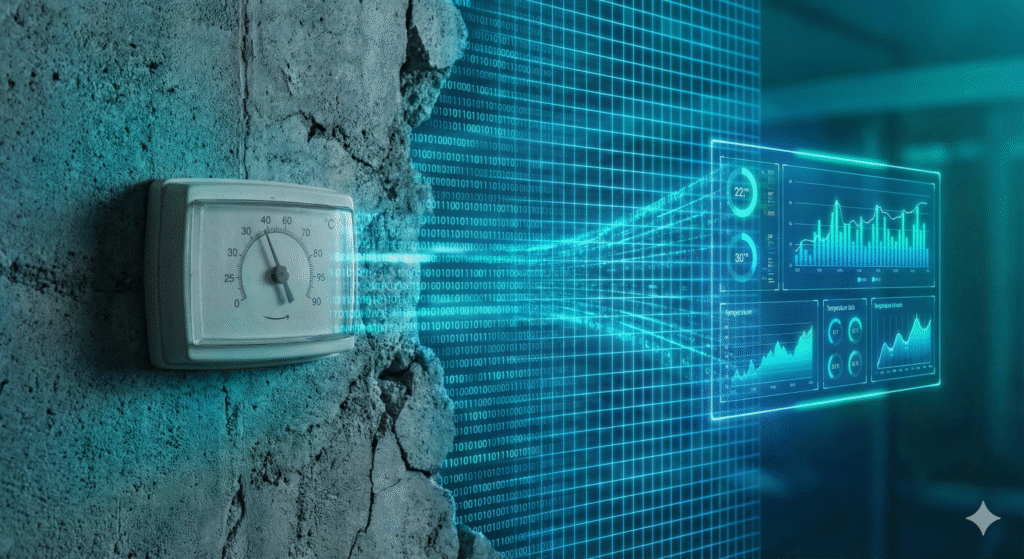
If the temperature in the lobby rises to 28°C, the Digital Twin sees it instantly. If a pump starts vibrating abnormally in the basement, the Digital Twin “feels” it. It is a bidirectional bridge between the physical and digital worlds.6
The Three Layers of a Digital Twin
- The Physical Asset: The actual building equipped with sensors (temperature, motion, CO2, vibration).7
- The Digital Thread: The connectivity layer (5G, Wi-Fi, LoRaWAN) that transmits the data.
- The Virtual Replica: The software interface where the “Twin” lives, analyzing data and visualizing it for human managers.
BIM vs. Digital Twin: The Critical Distinction
To truly grasp the power of Digital Twin Technology, we must distinguish it from its predecessor, BIM. While BIM is the foundation, Digital Twin is the operational evolution.8
| Feature | BIM (Building Information Modeling) | Digital Twin Technology |
| State | Static (Snapshot in time) | Dynamic (Real-time updates) |
| Focus | Design & Construction Phase | Operations & Maintenance Phase |
| Data Source | Architects & Engineers | IoT Sensors & User Feedback |
| Goal | Efficient Construction | Efficient Operation |
| User | Contractors & Designers | Facility Managers & Owners |
Digital Twin Technology picks up where BIM leaves off. It takes the “dead” geometry of a BIM model and infuses it with the “life” of sensor data.9
Case Study: The Smartest Building on Earth
Theory is fine, but let’s look at the “Rolls Royce” of Digital Twin Technology: The Edge in Amsterdam.
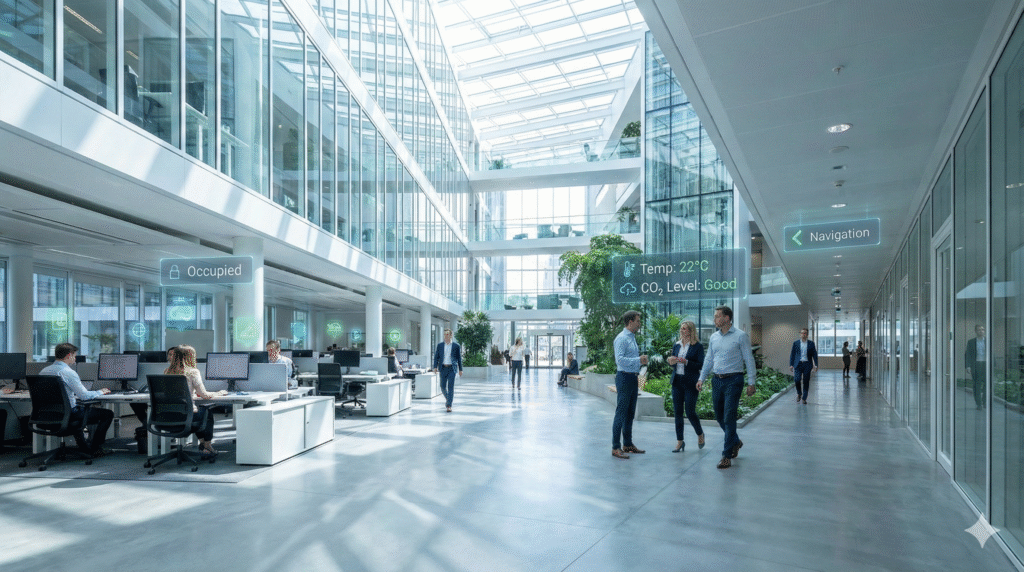
Often cited as the smartest and most sustainable office building in the world, The Edge is the ultimate proof of concept.10 It doesn’t just have a facility manager; it has a central nervous system.11
The Stats That Matter
- 28,000 Sensors: The building is packed with sensors that track motion, light, temperature, and humidity.12
- Smartphone Control: Every employee has an app.13 When they arrive, the building recognizes their car and directs them to a parking spot.14 Inside, the app allows them to customize the light and temperature of their specific workspace.
- Data-Driven Cleaning: In a traditional building, cleaners clean every room every night. At The Edge, the Digital Twin tells the cleaning team which rooms were actually used. If a meeting room wasn’t booked, it doesn’t get cleaned. This alone reduced cleaning costs significantly.
- 102% Energy Positive: Thanks to its smart facade and solar panels—optimized by its Digital Twin—The Edge produces more electricity than it consumes.
This is the power of Digital Twin Technology. It transforms a building from a cost center into an intelligent asset that optimizes itself.
Why 2025 is the Tipping Point
Why is Digital Twin Technology exploding right now? It comes down to the convergence of three factors:
1. The Cost of IoT Sensors Has Plummeted
Ten years ago, sensorizing a building cost a fortune. Today, IoT sensors are cheap, wireless, and have battery lives that last for years. You can stick a sensor on a water pump for $50 and instantly have a “smart pump.”
2. The Rise of Remote Management
Post-pandemic, facility managers need to manage portfolios remotely. A Digital Twin allows a manager in London to inspect a boiler room in Dubai without getting on a plane. They can “walk” through the building virtually and check the vitals of every system.
3. The Sustainability Mandate
With strict carbon regulations (like Local Law 97 in NYC or the EU Green Deal), building owners are panicked. They need to cut energy use.15 Digital Twin Technology acts as an energy detective, finding waste that humans miss—like an AC unit running full blast in an empty gym at 2 AM.
Key Benefits for Owners and Managers
Implementing Digital Twin Technology isn’t just about looking cool; it’s about the bottom line.
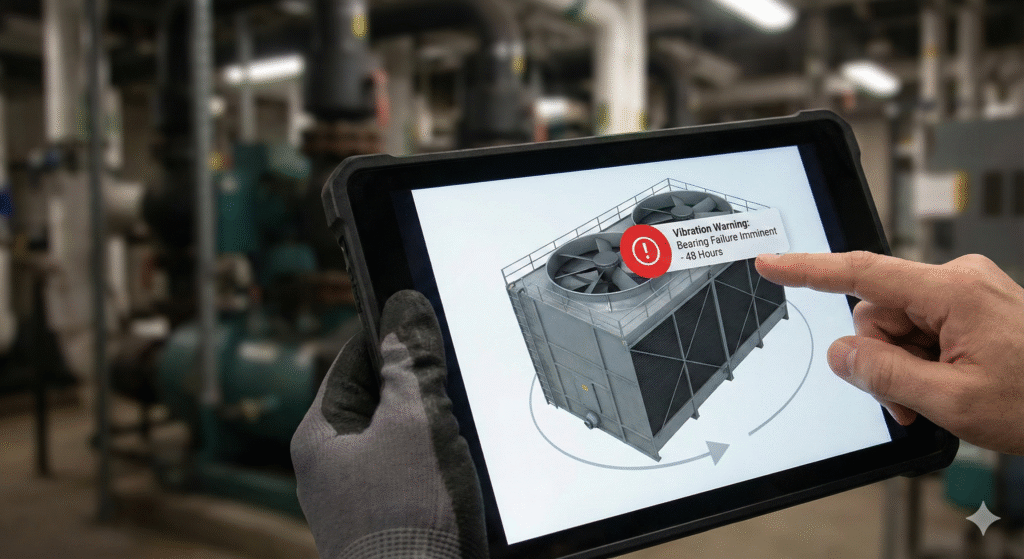
- Predictive Maintenance: Instead of fixing things when they break (Reactive), or fixing them on a schedule whether they need it or not (Preventive), the Twin tells you exactly when a part is about to fail.16 This extends asset life by up to 20%.17
- Space Optimization: Real-time occupancy heatmaps show which areas of a building are “dead zones.”18 Owners can repurpose this space or lease less square footage next time, saving millions in rent.
- Crisis Management: In an emergency like a fire, the Digital Twin becomes a lifesaver. It can instantly show first responders where people are trapped and which path is smoke-free.
Tools of the Trade: Building Your Twin
If you are ready to explore Digital Twin Technology, these are the platforms leading the charge in 2025:
- Autodesk Tandem: Specifically designed to turn BIM models into Digital Twins for facility monitoring.
- Azure Digital Twins (Microsoft): A powerful IoT platform that allows developers to model real-world environments and connect them to Azure’s cloud analytics.
- Willow (WillowTwin): A leader in real estate and infrastructure twins, famously used for the SoFi Stadium to manage crowds and facility health.19
- Matterport: Known for 3D scanning, they are moving heavily into the “digital twin as a data layer” space, making it easy to digitize existing buildings.


Conclusion
We are standing at the precipice of a new era in the built environment. The buildings of the future will not be judged solely by their aesthetics or their height, but by their intelligence.
Digital Twin Technology is the key that unlocks this intelligence. It allows us to converse with our concrete creations, listening to their needs and optimizing their performance in real-time. For building owners, it is the ultimate tool for value preservation. For occupants, it creates spaces that are healthier, more responsive, and more human.
The question is no longer “Can we build it?” but “How smart can we make it?”
Is Digital Twin Technology only for new buildings?
No. While it is easier to implement during construction, existing buildings can be “digitized.” This involves 3D laser scanning (using tools like Matterport) to create the geometry, followed by retrofitting wireless IoT sensors to provide the data stream.
How much does a Digital Twin cost?
The cost varies wildly based on complexity. A basic “energy twin” might cost a few cents per square foot, while a comprehensive “full control twin” like The Edge involves significant investment in custom software and sensor integration. However, the ROI is typically realized within 3-5 years through energy and maintenance savings.
Is my data safe?
Cybersecurity is the biggest challenge for Digital Twin Technology. Connecting a building to the cloud creates a potential entry point for hackers. It is vital to use enterprise-grade IoT security, encrypted data transmission, and segregated networks for building systems.
Can Digital Twin Technology replace facility managers?
No. It empowers them. It removes the tedious tasks of manual checking and data gathering, allowing managers to focus on strategic decision-making and occupant experience.
What is the difference between a Digital Twin and a Smart Building?
A “Smart Building” is the result (automation, lights turning off). The Digital Twin is the interface and the brain that makes the smart building understandable and manageable for humans. You can have a smart building without a twin, but it is much harder to manage.