Table of Contents
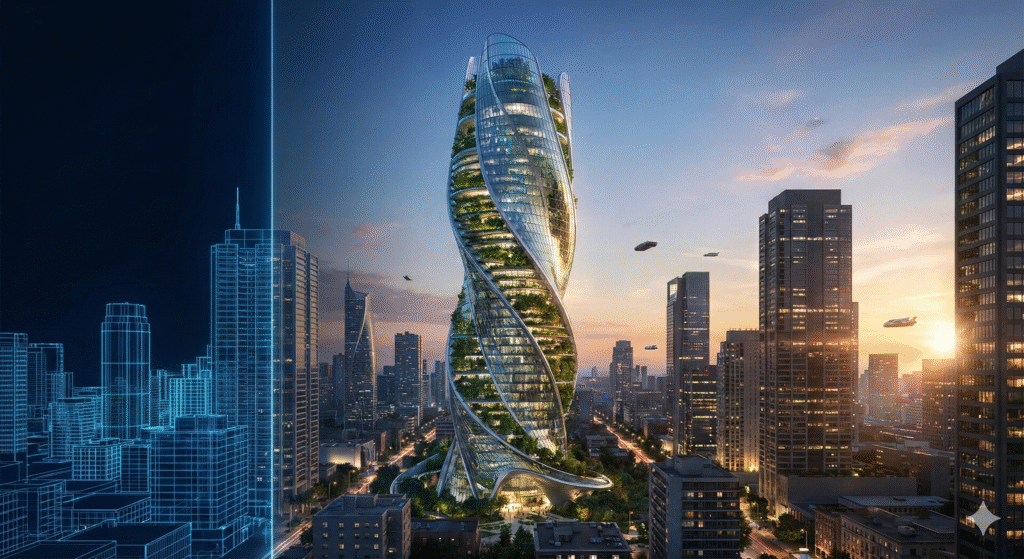
The way we imagine, design, and construct our world is undergoing a seismic shift. For centuries, architects have relied on intuition, geometry, and manual iteration to create buildings. From the sketches of Da Vinci to the blueprints of the 20th century, the process was linear. But today, we are witnessing the dawn of a new era: Generative Design in Architecture. This is not merely a software update; it is a fundamental rethinking of the relationship between human creativity and machine intelligence.
Generative Design in Architecture is the co-creation process where architects and artificial intelligence collaborate to solve complex design problems. Instead of drawing a building, the architect defines the goals and constraints—light, structural integrity, material cost, spatial flow—and the AI generates thousands of potential solutions. It is the ultimate evolution of “form follows function,” but now, form follows algorithm.
In this deep dive, we will explore how this technology works, why it is revolutionizing the industry, and what it means for the future of human architects.
What Exactly is Generative Design in Architecture?
To understand Generative Design in Architecture, we must first distinguish it from traditional Computer-Aided Design (CAD). In traditional CAD, the computer is a passive tool; it is a digital pencil. You draw a line, and the computer records it.
In contrast, generative design uses the computer as an active partner. It utilizes algorithms and cloud computing to explore the entire solution space of a design problem.
The Three Pillars of the Process
- Goal Definition: The architect inputs specific parameters. For example, “I need an office layout for 500 people that maximizes natural light, minimizes walking distance to exits, and stays within a specific thermal performance range.”
- Generation: The AI uses evolutionary algorithms—similar to how nature evolves organisms—to generate thousands of design iterations. It tests “mutations” of the design to see which ones perform best.
- Selection: The architect reviews the high-performing options. They don’t have to draw them; they simply curate the best solution based on aesthetics and data.
Generative Design in Architecture transforms the architect from a creator of geometry to a curator of possibilities.

The Evolution: From Parametric to Generative
Many professionals confuse parametric design with Generative Design in Architecture. While they are related, they are distinct steps on the evolutionary ladder.
- Parametric Design: This involves defining relationships between parts. If you move a wall, the roof adjusts automatically based on a formula. However, the architect still explicitly defines the shape.
- Generative Design: This takes it a step further. The architect defines the outcome, and the machine figures out the geometry.
This shift is crucial because modern buildings are incredibly complex. Balancing energy efficiency, structural load, material cost, and aesthetic appeal is a multi-dimensional puzzle that the human brain struggles to solve simultaneously. Generative Design in Architecture excels at this multi-objective optimization.
Why Now? The Perfect Storm
Why is Generative Design in Architecture exploding right now? It is the convergence of three technologies:
- Unlimited Cloud Computing: We can now run billions of calculations in seconds.
- Advanced Algorithms: Machine learning models have become sophisticated enough to understand physics and spatial logic.
- Big Data: We have decades of construction data to train these models on.
The Core Benefits of AI-Driven Design
The adoption of Generative Design in Architecture isn’t just about making cool-looking, futuristic shapes (though it does that well). It solves practical, expensive problems in the construction industry.
1. Radical Sustainability
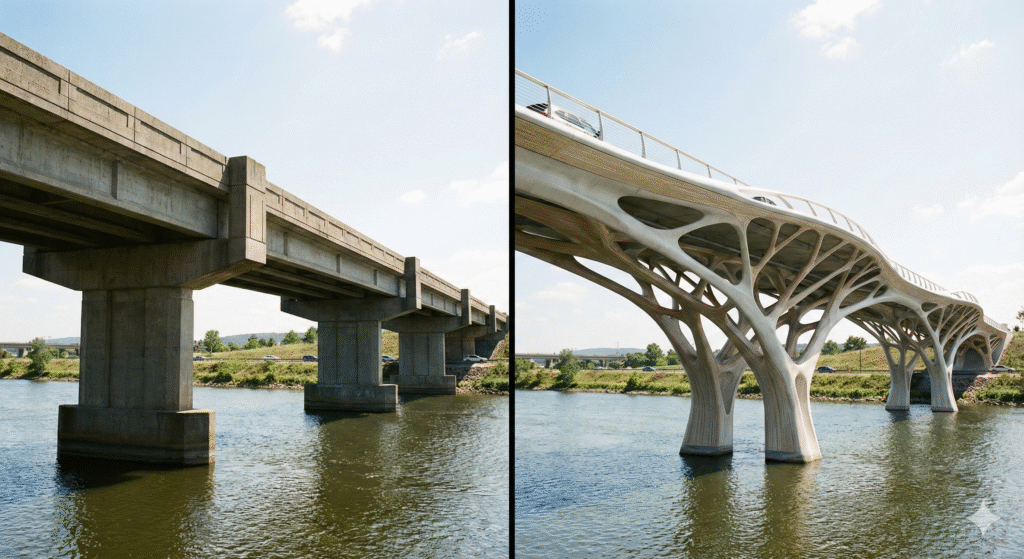
The construction industry is a massive contributor to global carbon emissions. Generative Design in Architecture can optimize structures to use the absolute minimum amount of material required for stability. This is often called “topology optimization.” By shaving off 20% of concrete or steel from a skyscraper without compromising safety, the carbon footprint drops drastically.
2. Cost and Waste Reduction
Construction waste is a trillion-dollar global problem. By simulating the construction process and optimizing material usage during the design phase, generative algorithms ensure that what is ordered is exactly what is needed. This precision engineering reduces budget overruns significantly.
3. Enhanced Creativity
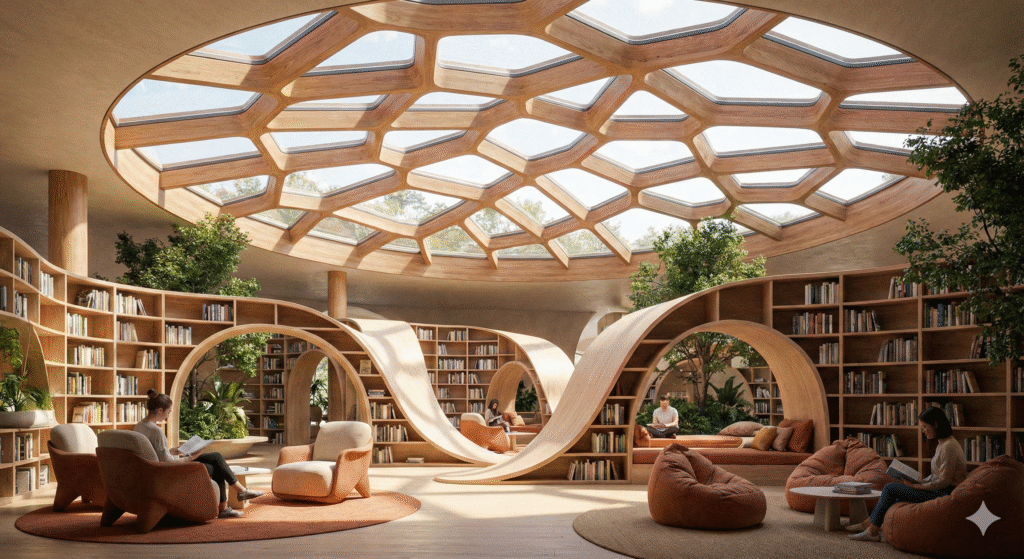
This might seem counterintuitive. Doesn’t AI kill creativity? On the contrary, Generative Design in Architecture frees the architect from the drudgery of geometry. It offers options that a human might never consider because of our cognitive biases. It presents “happy accidents”—novel forms and layouts that are structurally sound but aesthetically unique.
Real-World Applications: Who is Using It?
Generative Design in Architecture is no longer a theoretical concept; it is building our world today.
Zaha Hadid Architects
The late Zaha Hadid was known as the “Queen of the Curve.” Her firm continues to push boundaries using computational design. They utilize generative scripts to manage the complex geometry of their parametric facades, ensuring that the beautiful, sweeping curves can actually be manufactured and assembled.
Autodesk and The NASA Lander
Autodesk, a leader in design software, used generative design to create an interplanetary lander concept for NASA. The goal was to reduce weight while maintaining strength. The result was a spider-like structure that looked more biological than mechanical—a hallmark of Generative Design in Architecture.
Urban Planning
It’s not just about single buildings. Generative design is being used to plan entire neighborhoods. By inputting wind patterns, solar gain, and traffic flow, AI can layout city blocks to maximize pedestrian comfort and energy efficiency.
The Human Element: Will AI Replace Architects?
This is the most common fear surrounding Generative Design in Architecture. If the computer draws the building, what does the architect do?
The answer lies in the definition of the role. The architect becomes the conductor rather than the musician. The AI can generate 10,000 options, but it cannot judge beauty, cultural context, or the emotional resonance of a space. It doesn’t know how a sunset feels in a lobby or the cultural significance of a specific material in a local community.
Generative Design in Architecture creates a partnership. The AI handles the “how” (how to make this stand up, how to make this energy efficient), while the human handles the “why” (why we are building this, who it is for, and how it should feel).
Note: The most successful firms of the next decade will be those who master the language of algorithms, not just the language of form.
Tools of the Trade
If you are looking to get into Generative Design in Architecture, you need to know the ecosystem.
- Rhino + Grasshopper: The gold standard. Grasshopper is a visual scripting language that allows architects to build generative algorithms without writing raw code.
- Autodesk Revit + Dynamo: Similar to Grasshopper but integrated directly into the BIM (Building Information Modeling) workflow.
- Spacemaker (now part of Autodesk): An AI tool specifically for early-stage site analysis and urban planning.
- TestFit: A generative tool for real estate feasibility, instantly generating building layouts based on zoning data.
Learning these tools is essential for anyone who wants to remain relevant in the era of Generative Design in Architecture.
The Future: Digital Twins and Living Buildings
The future of Generative Design in Architecture extends beyond the blueprint. It moves into the lifecycle of the building itself.
We are moving toward “Digital Twins”—virtual replicas of physical buildings that are connected via sensors. A generative algorithm could monitor the real-time data of a building (temperature, occupancy, stress) and suggest renovations or adjustments to the physical structure over time.
Imagine a building that “grows” or adapts. With the advent of 4D printing (materials that change shape over time), Generative Design in Architecture could lead to buildings that self-shade on hot days or tighten their insulation on cold nights, driven by the same algorithms that designed them.

Conclusion
Generative Design in Architecture is the most significant leap forward since the invention of the blueprint. It is not a trend; it is the inevitable future of a world that demands more efficient, sustainable, and complex structures.
By leveraging the power of AI, we are moving away from the limitations of human geometry and entering an era of biological, optimized, and intelligent design. For architects, engineers, and designers, the message is clear: Embrace the algorithm. The future belongs to those who can co-create with the machine.
FAQ
Will Generative Design in Architecture replace human architects?
No. Generative design is a tool that augments human capability. While it handles complex calculations and geometry generation, humans are still required to define the goals, constraints, aesthetic direction, and cultural context of the project.
Is Generative Design the same as Parametric Design?
Not exactly. Parametric design relies on the architect defining the rules and shapes explicitly. Generative Design in Architecture involves the architect defining the goals, and the AI generating the geometry to meet those goals.
Is Generative Design expensive to implement?
Initially, there is a learning curve and software investment. However, Generative Design in Architecture typically saves money in the long run by reducing construction waste, optimizing materials, and preventing costly errors before construction begins.
What software is best for Generative Design in Architecture?
The industry leaders are currently Rhinoceros 3D with the Grasshopper plugin, and Autodesk Revit with the Dynamo plugin. Newer AI-specific tools like TestFit and Spacemaker are also gaining popularity.
How does Generative Design help sustainability?
It allows for “lightweighting”—removing unnecessary material from structures without losing strength. This significantly reduces the carbon footprint associated with producing concrete and steel.