Table of Contents
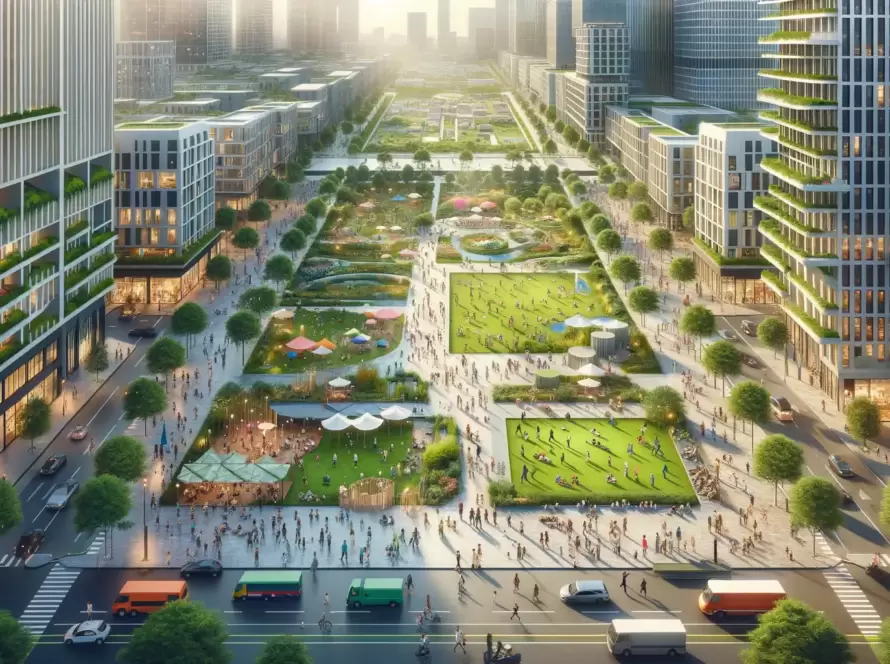
The era of the “dumb box” is over. For centuries, architecture was defined by statics: gravity, load-bearing walls, and permanent materials. But as we step further into the mid-2020s, a new fundamental force has entered the design chat: data. IoT in Smart Buildings (Internet of Things) has graduated from a novelty add-on to a core design principle. It is no longer just about putting a smart thermostat on the wall; it is about embedding a digital nervous system into the very concrete and steel of our creations.
For architects, this represents a profound shift. We are no longer just designing spaces for people to inhabit; we are designing ecosystems that inhabit the space alongside them. We are creating “Cognitive Buildings”—structures that sense, think, and adapt.
The integration of IoT in Smart Buildings is reshaping how we approach sustainability, user experience, and spatial planning. If you are an architect today, you are part designer, part data scientist. In this comprehensive guide, we will explore the top integration trends that are defining the skyline of tomorrow and how you can leverage them to build not just for the present, but for the future.
The Evolution: From Connected to Cognitive
To understand where we are going, we must look at the trajectory of IoT in Smart Buildings.
- Phase 1 (2010s): Connected Devices. Smart lights and thermostats that could be controlled via an app.
- Phase 2 (Early 2020s): Integrated Systems. The HVAC talking to the lighting system to save energy.
- Phase 3 (2025 & Beyond): Cognitive Environments. The building uses AI and IoT to predict needs before they arise.
This third phase is where the architect’s role becomes critical. You cannot retrofit “cognitive” behavior; you have to design for it.
The Invisible Architecture
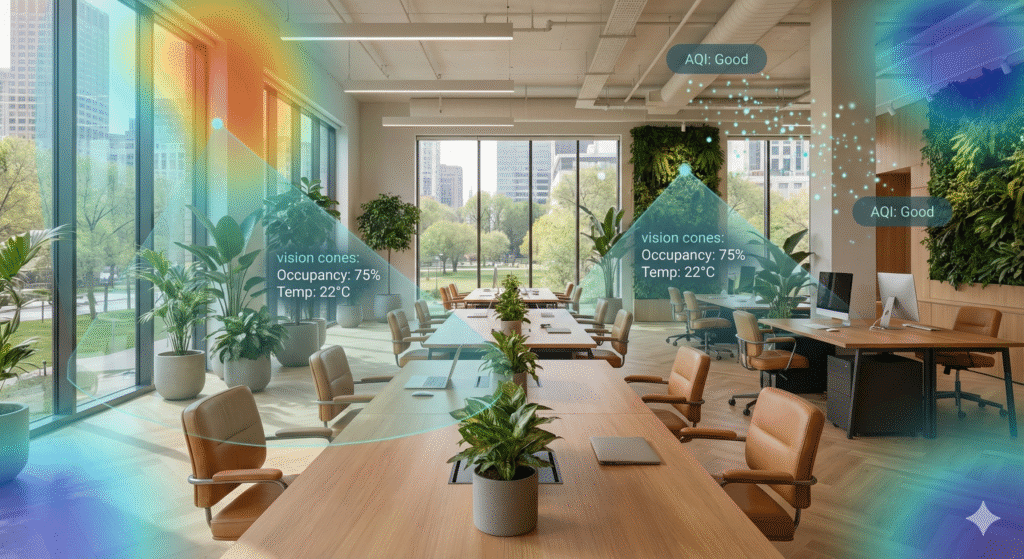
The challenge for modern architects is integrating this technology without cluttering the aesthetic. IoT in Smart Buildings should be felt, not seen. This requires a mastery of “Invisible Tech”—embedding sensors into drywall, utilizing Li-Fi (Light Fidelity) for data transmission through illumination, and designing server rooms that are as central to the floorplan as the elevator core.
Trend 1: The Digital Twin as the Design Canvas
The most significant trend facilitating IoT in Smart Buildings is the Digital Twin. A Digital Twin is a dynamic virtual replica of the physical building.
For architects, this changes the handover process. You aren’t just handing over blueprints; you are handing over a live digital entity.
- BIM to Twin: The Building Information Modeling (BIM) files you create during design become the skeleton of the Digital Twin.
- Real-Time Feedback: Once the building is built, IoT sensors feed data back into this model.
- The Loop: This allows architects to see how their designs perform in the real world. Did that atrium actually improve airflow? The Digital Twin data will tell you, informing your next design.
Architectural Takeaway: Design your BIM models with the operational phase in mind. Tag assets not just for construction, but for future data sensing.
Trend 2: Human-Centric Sensing (The “Well” Standard)
The focus of IoT in Smart Buildings has shifted from purely “energy saving” to “people saving.” Post-pandemic, the quality of the indoor environment is a non-negotiable asset.
IEQ (Indoor Environmental Quality) Sensors
Modern buildings are now equipped with granular sensor arrays that monitor:
- CO2 Levels: Adjusting ventilation instantly to prevent lethargy in meeting rooms.
- VOCs and Particulates: Detecting pollutants from furniture off-gassing or outside smog.
- Circadian Lighting: IoT lighting systems that change color temperature based on the time of day to match the human biological clock.
Architectural Takeaway: You need to design ceiling planes and wall cavities that can house these sensor arrays aesthetically. Avoid the “acne” of plastic sensors cluttering your beautiful clean lines by specifying materials that are IoT-permeable or integrated.

Trend 3: Predictive Energy Management & The Grid-Interactive Building
Sustainability is the primary driver for IoT in Smart Buildings. However, 2025 brings a new concept: the Grid-Interactive Efficient Building (GEB).
Buildings are no longer just consumers of energy; they are batteries.
- Predictive Cooling: IoT sensors combined with weather forecasts allow the building to “pre-cool” itself during off-peak hours when electricity is cheap.
- Automated Shading: Smart glass (electrochromic glass) tints automatically based on the sun’s position, reducing the load on the HVAC system before the room even heats up.
- Space Utilization: Why heat the whole 40th floor if the IoT access badges show only three people are up there? The building automatically creates “micro-climates” around the occupants.
Architectural Takeaway: This influences facade design. The envelope of the building becomes an active machine part, not just a barrier. Architects must collaborate early with energy modelers to integrate these active systems.
Trend 4: Space-as-a-Service (SPaaS) and Flexibility
The hybrid work model is here to stay. This means office buildings are no longer static rows of cubicles; they are flexible hubs. IoT in Smart Buildings is the enabler of this flexibility.
The Hot-Desking Evolution
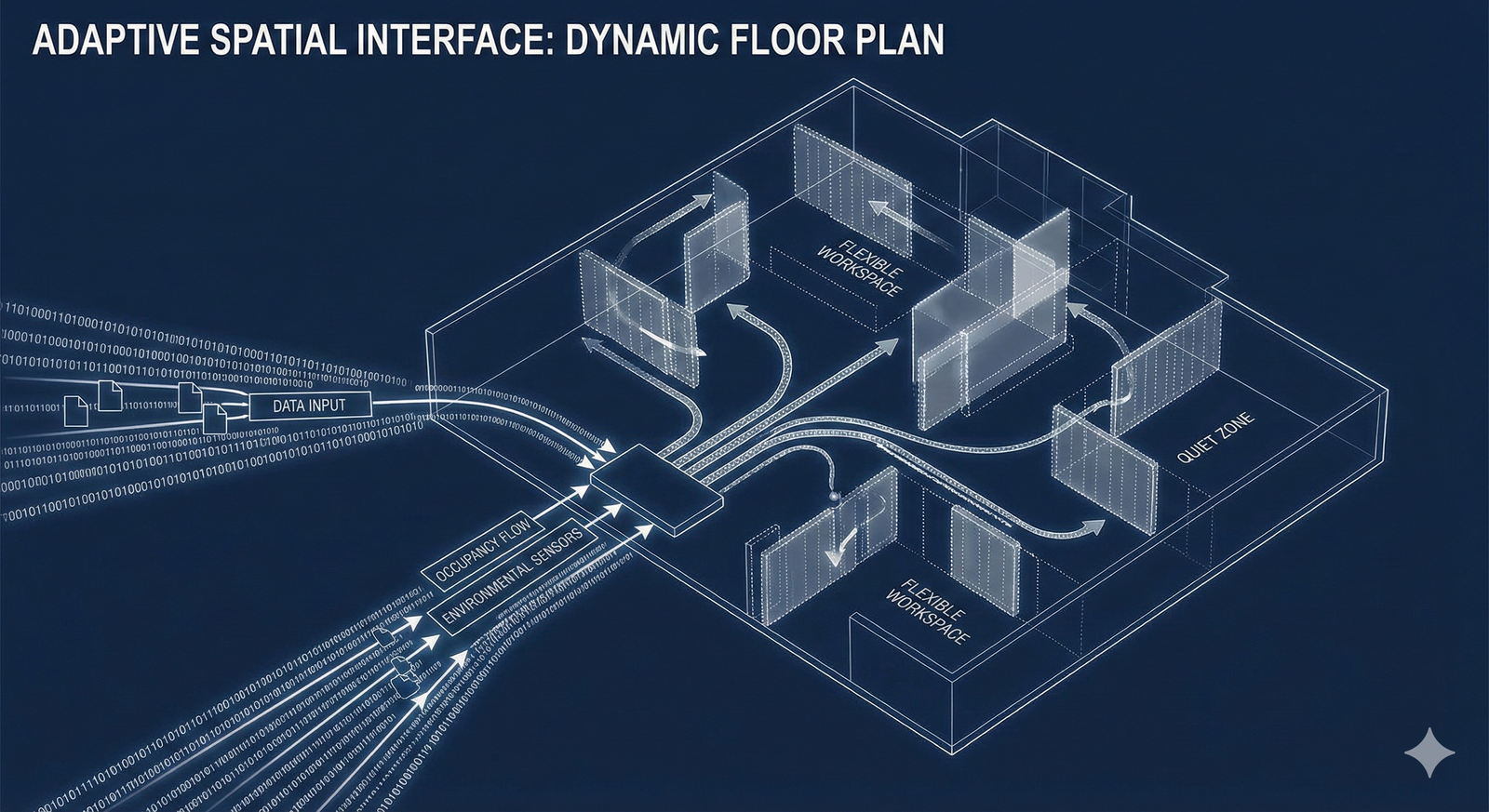
Sensors under desks and in chairs track utilization rates in real-time.
- Scenario: An architect designs a library space. The IoT data shows it is used 90% of the time, while the boardroom is used 10% of the time.
- Adaptation: The building management system suggests (or even automates via moveable walls) the reconfiguration of the space.
This leads to Parametric Spatial Programming, where the layout of a building can change based on data.
Trend 5: Security by Design (Cyber-Physical)
As we fill our buildings with sensors, cameras, and servers, we create a new vulnerability: hacking. A hacked building could mean locked doors, overheated server rooms, or stolen surveillance footage.
IoT in Smart Buildings requires architects to think like cybersecurity experts.
- Physical Segregation: Designing dedicated, secure pathways for IoT cabling that are separate from public electrical ducts.
- Edge Computing Rooms: Designing small, cooled, secure server rooms closer to the source of data (the Edge) rather than one giant basement server farm. This reduces latency and increases security.
Architectural Takeaway: “Tech Closets” are no longer an afterthought. They are critical infrastructure that requires cooling, security, and prime placement.
Implementing the Strategy: A Checklist for Architects
How do you actually start designing for IoT in Smart Buildings? Here is a checklist for your next project.
- Define the “Use Cases” Early: Don’t just say “we want a smart building.” Ask the client: Do you want to track occupancy? Save energy? Improve security? The hardware follows the goal.
- Collaborate with the MSI: The Master Systems Integrator (MSI) is the new structural engineer. Bring them in during the concept phase, not the construction phase.
- Specify Open Protocols: Ensure the building systems use open standards (like BACnet, MQTT, or Matter). Avoid proprietary systems that lock the client into one vendor. A smart building that can’t be upgraded is a dumb investment.
- Design for Maintenance: Sensors fail. Batteries die. If you hide a sensor inside a beautiful sealed walnut ceiling panel, the facility manager will hate you. Design accessible hatches and modular panels.



Conclusion
The integration of IoT in Smart Buildings is not just a trend; it is the inevitable direction of the built environment. We are moving away from the era of “form follows function” to an era of “form follows data.”
For the architect, this is a liberation. It allows us to prove the value of our designs with hard numbers. It allows us to create spaces that care for their inhabitants. It allows us to build structures that are lighter on the planet because they are smarter in their operation.
The buildings of 2030 will be judged not just by their beauty, but by their intelligence. As architects, we hold the pen that writes the code for these physical-digital experiences. It is time to embrace the sensor as much as the brick.
FAQ
Does IoT in Smart Buildings increase the construction cost?
Yes, the initial capital expenditure (CapEx) is typically higher due to the cost of sensors, cabling, and software. However, the operational expenditure (OpEx) is significantly lower. Smart buildings often see an ROI within 3-5 years through energy savings and predictive maintenance.
Can IoT be retrofitted into older buildings?
Absolutely. This is a massive market. Wireless IoT sensors (using LoRaWAN or 5G) allow older buildings to become “smart” without ripping open walls to run cables. This is crucial for preserving heritage architecture while meeting modern sustainability codes.
What is the biggest challenge for architects regarding IoT?
The biggest challenge is interoperability. Ensuring the lighting system talks to the HVAC system, which talks to the security system. Architects need to specify systems that share a “common language” or platform.
How does IoT affect the aesthetics of a building?
It shouldn’t—if designed well. The trend is toward “ambient computing,” where the technology is hidden behind materials or integrated into fixtures. The goal is a seamless experience where the user benefits from the tech without seeing the hardware.
Is IoT secure?
It is a risk vector. That is why “Security by Design” is a top trend. Architects must design physical security for network infrastructure, and clients must invest in enterprise-grade cybersecurity software to protect the building’s digital twin.