Table of Contents
In the history of architecture, there have been pivotal moments where the medium of creation changed the output of the creator. The switch from stone to steel allowed us to touch the clouds. The switch from hand-drawing to CAD allowed us to standardize precision.1 Today, we are living through the next great shift: the adoption of Parametric Design.
For the uninitiated, Parametric Design can seem like a buzzword synonymous with “weird, curvy shapes” or the avant-garde works of Zaha Hadid. But to view it only as an aesthetic style is to miss the point entirely. Parametric Design is not a style; it is a method. It is a fundamental rethinking of the architectural process from “drawing lines” to “writing logic.”
In a traditional workflow, an architect draws a wall. If the client wants the wall moved two meters, the architect erases it and redraws it. In a Parametric Design workflow, the architect defines the relationships.2 “This wall is always 5 meters from the boundary.” If the boundary moves, the wall moves automatically.
This shift—from explicit modeling to associative modeling—is unlocking capabilities that were previously impossible. It allows us to optimize buildings for climate, structure, and cost in real-time.3 It enables the fabrication of complex geometries that mimic the efficiency of nature.4
In this extensive guide, we will peel back the layers of Parametric Design, exploring its history, its tools, its practical applications, and why it is the essential skill for the architect of the future.
What is Parametric Design? The Core Philosophy
At its simplest, Parametric Design is a process based on algorithmic thinking.5 It involves establishing rules and parameters that clarify the relationship between design intent and design response.6
Think of a spreadsheet. In Excel, if you change the number in cell A1, the sum in cell B1 updates automatically because you defined a formula ($A1 + 10 = B1$). Parametric Design is essentially a visual spreadsheet for geometry.
The Shift from Explicit to Implicit
- Explicit Modeling (The Old Way): You are the sculptor. You click the mouse to place a point. You drag a line. The computer records exactly what you did. The geometry is static.
- Implicit/Parametric Modeling (The New Way): You are the conductor. You tell the computer, “Create a point that is the midpoint between A and B.” You never touch the point itself; you manage the rule that creates it.
This power of association is what makes Parametric Design so potent. It allows architects to explore thousands of iterations in the time it used to take to draw one.7 It transforms the architect from a creator of static objects into a creator of systems.
The Evolution: From Gaudi to Grasshopper
While Parametric Design feels futuristic, its roots are analog.
Antoni Gaudi: The Analog Pioneer
Long before computers, Antoni Gaudi was using parametric principles.8 For the design of the Sagrada Familia, he used a “hanging chain model.” By hanging weights on strings, gravity naturally calculated the optimal catenary curves for the arches. If he moved a weight (a parameter), the entire shape of the arch changed (the result).9 He was computing with gravity.
The Frank Gehry Era
In the 1990s, Frank Gehry adopted CATIA (software designed for aerospace) to realize the Guggenheim Bilbao.10 This was the moment the industry woke up. It proved that complex, non-Euclidean geometry could be built on a budget if the computer could rationalize the curves into manufacturable panels.
The Grasshopper Revolution
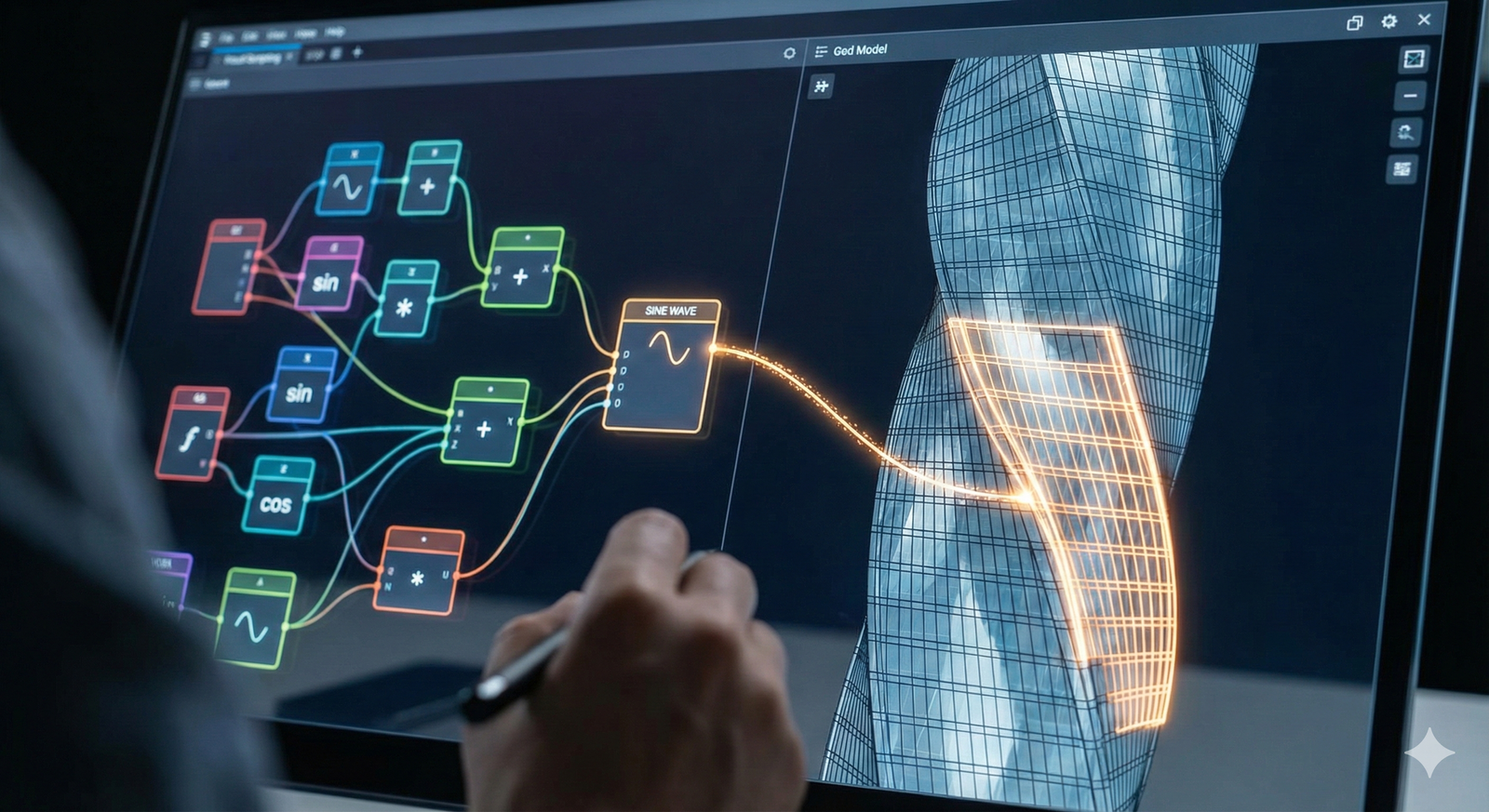
The true democratization of Parametric Design arrived with Grasshopper 3D, a plugin for Rhino.11 Before Grasshopper, you needed to know how to write code (Python, C++) to create algorithms. Grasshopper replaced code with “batteries” and wires. Suddenly, visually-minded architects could “program” geometry without learning syntax. This exploded the popularity of Parametric Design in schools and firms worldwide.
Why Use Parametric Design? The Three Pillars
Why go through the trouble of setting up complex algorithms? Parametric Design offers three distinct advantages that traditional CAD cannot touch.
1. Optimization and Performance
This is the most practical application. Parametric Design allows you to link geometry to data.
- Solar Analysis: You can write a script that says, “Rotate each window louver individually to block the sun at 2 PM in July.” The computer calculates the angle for 5,000 louvers in seconds.
- Structural Efficiency: You can use “topology optimization” to remove material from a steel beam where it isn’t experiencing stress.12 The result is a bone-like structure that is lighter, cheaper, and stronger.
2. Managing Complexity
Modern buildings are incredibly complex. Designing a stadium skin with 20,000 unique panels manually is a recipe for insanity and errors. Parametric Design automates the tedious.13 You define the rule for the paneling, and the software generates the schedule, labels every panel, and unrolls them for laser cutting.
3. Adaptability
In the early stages of a project, everything changes. The client wants the tower to be 10 stories higher. In a traditional workflow, that’s a week of work. In a Parametric Design workflow, you slide the “Height” number slider from 50 to 60, and the entire tower—including the structure, facade, and floor area calculations—updates instantly.
The Aesthetic of Algorithms: Is it Just “Blobitecture”?
There is a common criticism that Parametric Design leads to “Blobitecture”—buildings that look like melting amoebas just because the software makes it easy to draw curves.
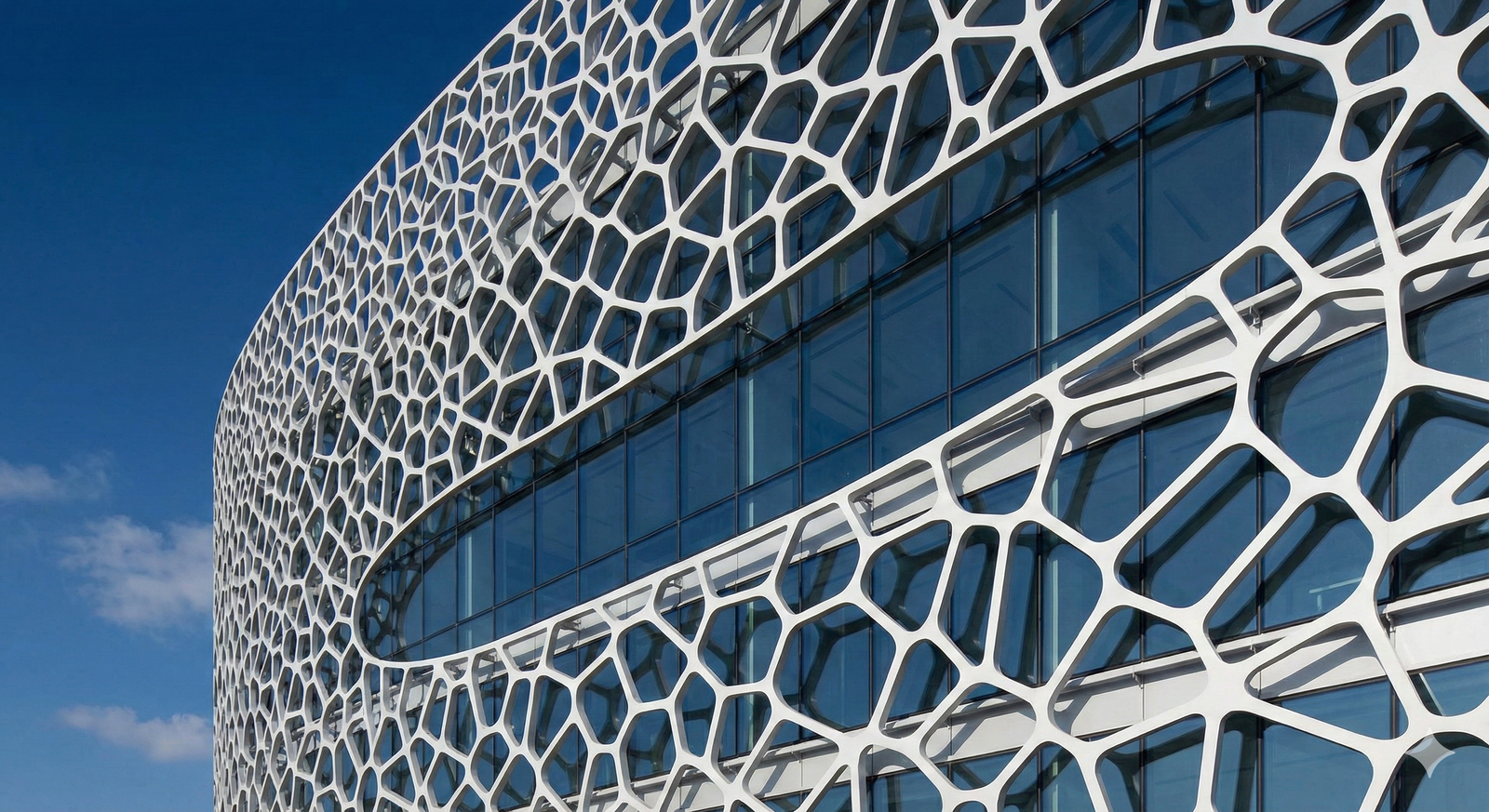
While the “Zaha Hadid style” of sweeping curves is the most famous face of Parametric Design, the method is equally applicable to a rigid, rectangular box.
- You can use Parametric Design to lay out a perfect brick grid.
- You can use it to optimize the layout of a rectangular hospital to minimize nurse walking distances.
The aesthetic of the curve is a choice, not a requirement. However, the reason we see so many organic shapes is that Parametric Design allows us to mimic nature.14 Nature rarely builds in straight lines.15 Trees, bones, and shells are optimized forms created by the “parameters” of evolution. Architects are now using these same evolutionary algorithms to grow buildings.
Tools of the Trade
To become proficient in Parametric Design, you need to master specific software ecosystems.
- Rhino + Grasshopper: The undisputed king. It is the industry standard for high-end design, fabrication, and complex geometry. The ecosystem of plugins (Ladybug for climate, Kangaroo for physics, Karamba for structure) is unmatched.
- Revit + Dynamo: The corporate standard. Dynamo is Autodesk’s answer to Grasshopper. It integrates directly with BIM (Building Information Modeling). While less flexible for pure geometry than Grasshopper, it is powerful for automating documentation and data management.
- Houdini: Originally a VFX tool for movies, Houdini is gaining traction in architecture for its incredible procedural generation capabilities, especially for city planning and vast terrains.
- Blender + Geometry Nodes: The free, open-source contender.16 Blender’s Geometry Nodes are becoming powerful enough to rival paid software, making Parametric Design accessible to everyone.
The Future: AI and Generative Design
Parametric Design is the stepping stone to the next revolution: Generative Design.
In parametric modeling, you define the logic.17 In generative design, you define the goal, and the AI figures out the logic.18
- Parametric: “Make a chair with 4 legs, 40cm high.”
- Generative: “Make something I can sit on that holds 100kg and uses the least amount of wood possible.”
The software will then iterate through thousands of Parametric Design variations, evolving them like a biological species, and present you with the fittest options.
We are entering an era of “Co-Design,” where the architect is the curator and the computer is the generator. The skills learned in Parametric Design—understanding logic, data, and constraints—are the prerequisites for working with these AI tools.
Conclusion
Parametric Design is more than a trend; it is the maturation of the digital age in architecture.19 It represents the move from using the computer as a drafting board to using it as a computation engine.
For the modern architect, ignoring Parametric Design is becoming a liability. Clients are demanding more sustainable, more complex, and more cost-effective buildings. The manual methods of the past simply cannot keep up with the data-driven demands of the present.
By embracing the algorithm, we do not lose our humanity or our creativity. Instead, we amplify it. We gain the ability to manage complexity that would otherwise overwhelm us, freeing our minds to focus on the poetry of space, light, and human experience.
The future is scripted. Are you ready to write it?

Frequently Asked Questions (FAQ)
Do I need to know how to code to do Parametric Design?
No. Most modern Parametric Design is done using “Visual Scripting” tools like Grasshopper or Dynamo. You connect nodes with wires rather than writing lines of text code (like Python or C#). However, knowing some coding logic helps.
Is Parametric Design only for large, expensive projects?
Not at all. While famous for stadiums and airports, Parametric Design is used for small installations, furniture design, and even residential renovations to calculate material costs or optimize sun shading.
What is the difference between CAD and Parametric Design?
CAD (Computer-Aided Design) is usually “Direct Modeling”—you draw a line, and it stays there. Parametric Design is “Associative Modeling”—you create a rule that draws the line. If you change the rule, the line updates.
Can Parametric Design help with sustainability?
Yes, it is one of its strongest use cases. You can use parametric tools to simulate wind, solar radiation, and thermal performance in real-time, allowing you to “sculpt” the building form to be as energy-efficient as possible.
Is Parametric Design expensive to implement?
The software (like Rhino) is relatively affordable compared to high-end BIM suites. The main investment is time—learning to think algorithmically takes practice. However, the time saved on revisions and automation often pays for the investment quickly.