Table of Contents
Regenerative architecture is more than just the new buzzword in the world of green building; it’s a fundamental paradigm shift. For decades, the gold standard for environmentally conscious construction has been “sustainable design.” We’ve strived to create buildings that are energy-efficient, use recycled materials, and minimize their carbon footprint. The goal has been noble and necessary: to do less harm. But what if our buildings could do more than just reduce their negative impact? What if they could actively do good?
This is the central promise of regenerative architecture. It challenges us to move beyond the goal of sustainability—which at its core means maintaining the status quo—and embrace a new mission: to design buildings that actively heal, restore, and revitalize the ecosystems they inhabit. It’s the difference between a car with great mileage and a tree. The car, no matter how efficient, still consumes resources and produces some waste. The tree, however, actively cleans the air, creates habitat, enriches the soil, and contributes positively to its environment. It’s time our buildings learned to act more like trees.
This blog post will explore the depths of regenerative architecture, contrasting it with traditional sustainable design, examining its core principles, and showcasing real-world examples that prove this visionary approach is not just possible, but essential for our future.
The Glass Ceiling of Sustainability
Let’s be clear: the sustainable design movement has been crucial. It brought concepts like LEED certification, passive solar design, and energy efficiency into the mainstream. It taught us to think about the lifecycle of materials, reduce our water consumption, and insulate our homes properly. These achievements have saved immense amounts of energy and prevented tons of carbon from entering the atmosphere.
However, sustainability has an inherent limitation: its ultimate goal is neutrality. A “net-zero” building, the pinnacle of sustainable design, aims to produce as much energy as it consumes. It seeks to have no negative impact. In a world already facing catastrophic climate change, biodiversity loss, and resource depletion, is “no negative impact” truly enough?
Breaking even isn’t winning the game; it’s just stopping the bleeding. We have already inflicted significant damage on our planet. The need of the hour isn’t just to stop causing harm, but to actively start healing the wounds. This is where the philosophy of regenerative architecture steps in, offering a more ambitious and hopeful path forward. It reframes the role of the built environment from being a passive consumer to an active contributor to ecological and social health.
Defining the Regenerative Revolution
So, what exactly is regenerative architecture?
At its heart, regenerative architecture is a holistic, systems-thinking approach to design that sees buildings as integral parts of a larger, living ecosystem. Instead of a machine that consumes resources, a regenerative building is envisioned as a living organism that co-evolves with its environment.
Regenerative architecture aims to create buildings and communities that are:
- Net-Positive: They generate more energy than they use, capture and purify more water than they consume, and sequester more carbon than they emit.
- Ecologically Restorative: They improve the health of the local ecosystem by restoring habitats, enhancing biodiversity, and regenerating soil.
- Socially Equitable: They promote human health, well-being, and community connection, ensuring fair access to resources for all.
- Place-Based: They are deeply rooted in the unique character of their location—its climate, ecology, culture, and history.
This approach demands a profound shift in perspective. An architect is no longer just a designer of objects but a facilitator of living systems. The design process begins not with a blank slate, but with a deep understanding of the “genius loci,” or the spirit of the place.

The Core Principles of Regenerative Architecture
To move from theory to practice, regenerative architecture is guided by a set of interconnected principles. These principles ensure a holistic approach that considers every aspect of a building’s impact.
1. Designing with Place (Genius Loci)
A regenerative project doesn’t impose a generic design onto a site. Instead, it begins with a deep investigation of the location. What are the natural water flows? What are the prevailing wind patterns? What native plants and animals live here? What is the cultural history of the land? The design emerges from this understanding, working with the natural systems, not against them. A building in the Arizona desert should look and function fundamentally differently from one in the Pacific Northwest, not just for aesthetic reasons, but because it is responding to a unique set of ecological conditions.
2. Biomimicry: Learning from Nature’s Genius
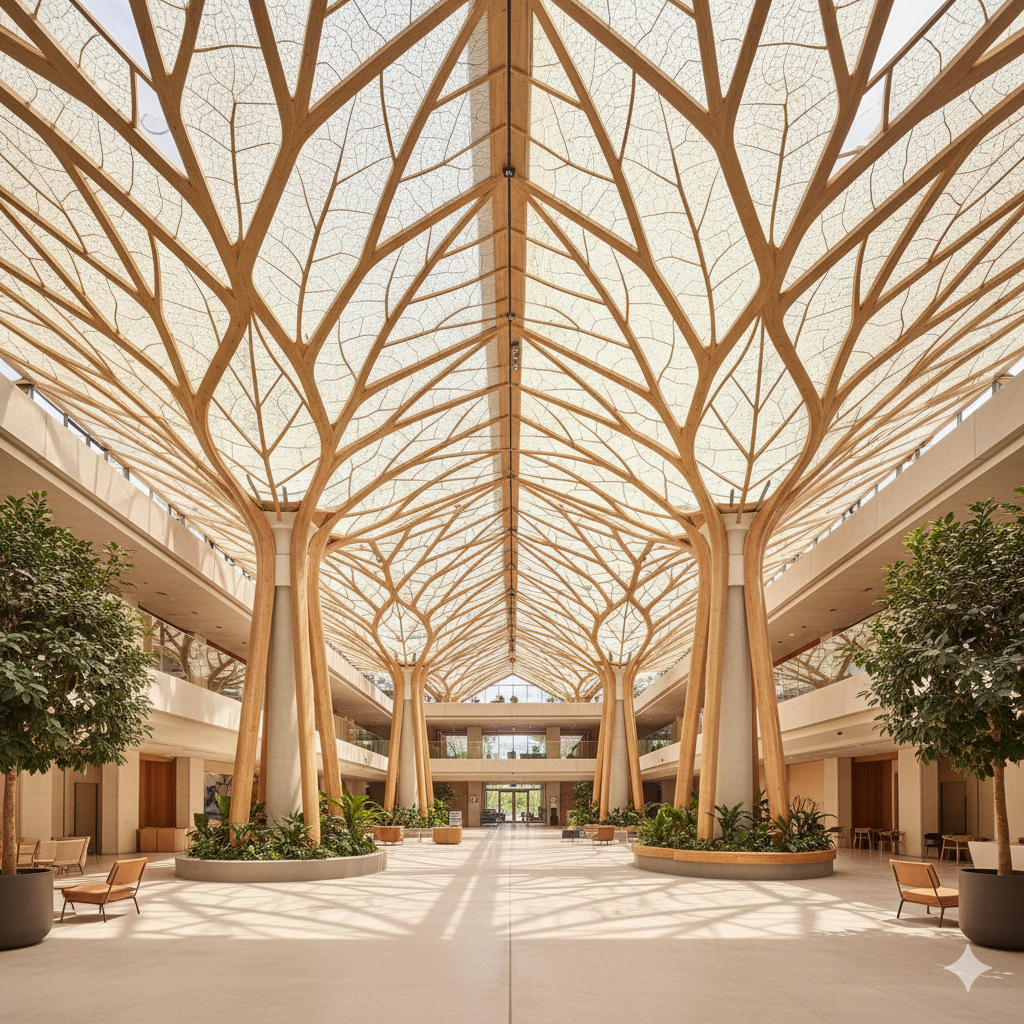
Nature has been solving design problems for 3.8 billion years. Biomimicry in architecture is the practice of observing and emulating the strategies found in nature to solve human design challenges. Why invent a complex, energy-intensive ventilation system when a termite mound can teach us how to maintain a stable internal temperature passively? Why create toxic dyes when we can learn from the structural color of a peacock’s feather? Regenerative architecture uses biomimicry to create buildings that are inherently efficient, resilient, and beautiful because they follow nature’s proven blueprints.
3. Becoming Net-Positive
This is a critical departure from the net-zero goal of sustainable design. A net-positive building is a powerhouse of production.
- Energy: It uses a combination of solar panels, geothermal systems, and extreme efficiency to generate more electricity than it needs, feeding the surplus back into the grid.
- Water: It captures rainwater, recycles greywater, and treats its own blackwater, often returning water to the aquifer cleaner than it was received.
- Carbon: It uses materials like mass timber and regenerative concrete that sequester carbon for the life of the building, effectively pulling CO2 out of the atmosphere.
4. Embracing Closed-Loop and Circular Systems
In nature, there is no such thing as waste. The output of one system is the input for another. Regenerative architecture applies this principle by designing for a circular economy. Buildings are designed for disassembly, so materials can be reused rather than demolished and sent to a landfill. On-site food waste is composted to enrich the soil for landscape gardens. Wastewater is treated and reused for irrigation. This closed-loop thinking minimizes resource extraction and eliminates the concept of waste entirely.
5. Fostering Social Equity and Well-being
A building cannot be truly regenerative if it doesn’t support the health and vitality of the people who use it and the community around it. This principle focuses on creating spaces that enhance human well-being through biophilic design (connecting people with nature), ensuring excellent indoor air quality, promoting physical activity, and creating spaces that foster community interaction. It also addresses larger issues of equity, ensuring that the benefits of the project—like clean energy, healthy food, and beautiful spaces—are accessible to all, not just a privileged few.
6. Adopting Living Systems Thinking
This is the philosophical glue that holds all the other principles together. It means viewing the project not as a static object, but as a dynamic, evolving part of a larger web of life. A regenerative project is designed to adapt and change over time, just like a natural ecosystem. It requires ongoing participation from its inhabitants, who become stewards of the building and its surrounding environment.
Regenerative Architecture vs. Sustainable Design: A Shift in Mindset
To truly grasp the difference, let’s compare the two approaches side-by-side.
| Feature | Sustainable Design | Regenerative Architecture |
| Primary Goal | Minimize negative impact (Do less harm) | Maximize positive impact (Heal and restore) |
| Target | Net-Zero / Carbon Neutral | Net-Positive / Carbon Negative |
| Metaphor | An efficient hybrid car | A thriving, productive forest |
| Approach to Nature | Seeks to protect nature from the building | Seeks to integrate the building with nature |
| System Focus | Technical, mechanical systems (Efficiency) | Living, whole systems (Effectiveness) |
| Waste | Minimize waste (Recycle, reduce) | Eliminate the concept of waste (Circular flows) |
| Human Role | Occupant / Consumer | Steward / Participant |
| Timescale | Focus on the building’s operational lifespan | Focus on multi-generational ecological health |
Export to Sheets
This table illustrates that while sustainable design is a crucial step in the right direction, regenerative architecture represents the full evolution of our thinking—from a mechanistic worldview to an ecological one.
Case Studies: Regenerative Architecture in the Real World
This isn’t just a utopian fantasy. Pioneers around the globe are already building the future.
The Bullitt Center – Seattle, Washington, USA
Often cited as the “greenest commercial building in the world,” the Bullitt Center is a living laboratory for regenerative architecture. It’s a net-positive energy building, with a prominent solar array that generates roughly 60% more energy than the building uses annually. It’s also net-positive water, capturing rainwater in a 56,000-gallon cistern for all its needs, including drinking water. It features composting toilets that turn human waste into fertilizer, eliminating sewage output. The entire structure is designed for a 250-year lifespan, a testament to long-term thinking.
Eastgate Centre – Harare, Zimbabwe
A masterpiece of biomimicry, the Eastgate Centre was designed by architect Mick Pearce to mimic the self-cooling mounds of African termites. The building has no conventional air-conditioning yet stays cool and comfortable year-round, even in Zimbabwe’s hot climate. It uses a passive cooling system of vents and chimneys that draw in cool night air and flush out the heat generated during the day. As a result, it consumes less than 10% of the energy of a comparable conventional building, saving its owners millions of dollars while providing a healthier indoor environment.
Phipps Conservatory and Botanical Gardens – Pittsburgh, Pennsylvania, USA
The Center for Sustainable Landscapes (CSL) at Phipps is one of the first and largest projects to achieve the Living Building Challenge, the most rigorous standard for regenerative architecture. It is net-positive energy and net-positive water. All of its wastewater is treated on-site with a constructed wetland and sand filters, and all storm water is managed within the grounds. The design actively restores a formerly degraded brownfield site, demonstrating how architecture can be a tool for ecological restoration.
The Challenges on the Road to Regeneration
Despite its immense promise, the path to a regenerative future is not without obstacles.
- Higher Upfront Costs: While regenerative buildings often have significantly lower lifecycle costs due to energy and water savings, their initial design and construction can be more expensive due to advanced systems and materials.
- Regulatory Hurdles: Many current building codes and zoning laws are not designed to accommodate innovative systems like composting toilets or greywater recycling, creating significant red tape for pioneering projects.
- A Scarcity of Expertise: Regenerative architecture requires a different skill set and a collaborative, interdisciplinary approach that many firms are not yet equipped for.
- The Mindset Shift: Perhaps the biggest challenge is convincing clients, developers, and policymakers to move beyond the short-term, cost-first mentality and embrace a long-term, value-based approach that prioritizes ecological and social health.
Conclusion: Building a Living Future
For too long, we have designed our world with a fundamentally extractive mindset. We take from the Earth, use what we need, and discard the rest. Sustainable design was the first major step away from this, a courageous attempt to curb our consumption and lessen our impact. But it’s time for the next step.
Regenerative architecture offers a compelling and hopeful vision for the future—a future where our buildings are not just shelters from the environment, but active partners with it. It’s a future where our cities function like forests, cleaning the air, producing energy, and fostering life. Shifting from a sustainable to a regenerative mindset is more than an architectural trend; it’s a necessary evolution in our relationship with the living world. It is about consciously deciding to become a species that heals and restores, not one that simply does less harm. The blueprints are rea/dy. It’s time to start building.

Is regenerative architecture much more expensive than conventional building?
While the upfront costs can be higher (5-15% more), the lifecycle costs are often significantly lower. A regenerative building saves money year after year on energy and water bills. Furthermore, as technologies mature and supply chains develop, these upfront costs are expected to decrease.
What is the Living Building Challenge?
The Living Building Challenge (LBC) is the world’s most rigorous performance standard for buildings. It is a philosophy, certification, and advocacy tool for regenerative design projects. To be certified, projects must meet seven stringent performance areas, or “Petals,” including Place, Water, Energy, Health + Happiness, Materials, Equity, and Beauty.
Can I apply regenerative principles to my own home?
Absolutely! While a full Living Building certification might be challenging for a single-family home, the core principles are scalable. You can install a rainwater harvesting system, plant a native garden to support local biodiversity, add solar panels, choose non-toxic materials for renovations, and improve your home’s insulation and natural ventilation. Every positive step contributes to a more regenerative culture.
How does regenerative architecture relate to biophilic design?
Biophilic design, the practice of connecting humans to nature within the built environment, is a key component of regenerative architecture. It falls under the principle of fostering human health and well-being. A regenerative building uses biophilic elements like natural light, interior plants, natural materials, and views of nature to create healthier, happier, and more productive spaces for people.
Is this approach only for new buildings?
No, regenerative principles can be applied to retrofitting existing buildings as well. A deep energy retrofit, the addition of green roofs and living walls, the implementation of on-site water recycling systems, and community urban agriculture projects are all ways to transform existing structures and neighborhoods into more regenerative systems.