For most of the 20th century, architecture had a favorite client. His name was “The Modulor Man.” Created by Le Corbusier, he was 6 feet tall, able-bodied, young, and strong. He was the standard against which all doors, stairs, and countertops were measured.
There is just one problem: He doesn’t exist.
In the real world, people get old. They break legs. They push strollers. They have autism. They lose their sight. By designing for a mythical “average” human, architects have historically excluded vast swathes of the population. But a paradigm shift is underway. We are moving from the era of “Accommodation” to the era of Universal Design.
Universal Design is not about checking boxes for disability codes or adding an ugly metal ramp to the back of a building. It is a design philosophy that seeks to create environments that are usable by all people, to the greatest extent possible, without the need for adaptation or specialized design.
It is the belief that a building is not truly beautiful unless it is beautiful for everyone. In this comprehensive guide, we will move beyond the basics of ADA compliance and explore the 7 Principles of Universal Design, the economic power of the “Curb Cut Effect,” and how you can architect spaces that celebrate the full spectrum of human diversity.
Universal Design vs. Accessibility: What’s the Difference?
Before we dive into the mechanics, we must distinguish Universal Design from Accessibility. They are cousins, not twins.
- Accessibility is a function of compliance. It focuses on the minimum requirements (like the Americans with Disabilities Act) to ensure people with disabilities aren’t physically barred from a space. It often results in “separate but equal” solutions: the main stairs are for the “normal” people, and the lift around the corner is for “the others.”
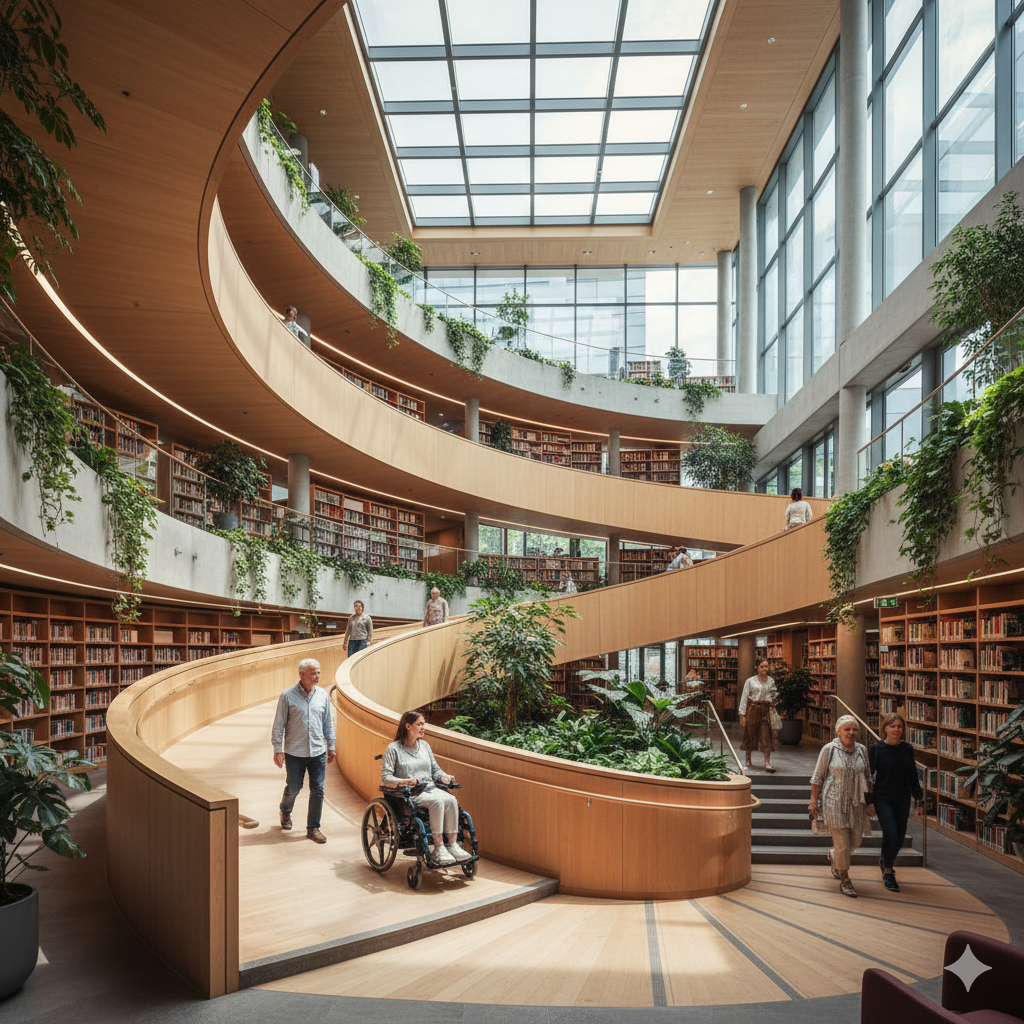
- Universal Design is a function of inclusion. It integrates the solution into the main design. In a Universal Design project, there is no “handicapped entrance.” The main entrance is accessible to everyone. The ramp is the sculpture. The handle is usable by a closed fist.
Universal Design creates a sense of belonging. It says, “You were expected here.”
The 7 Principles of Universal Design
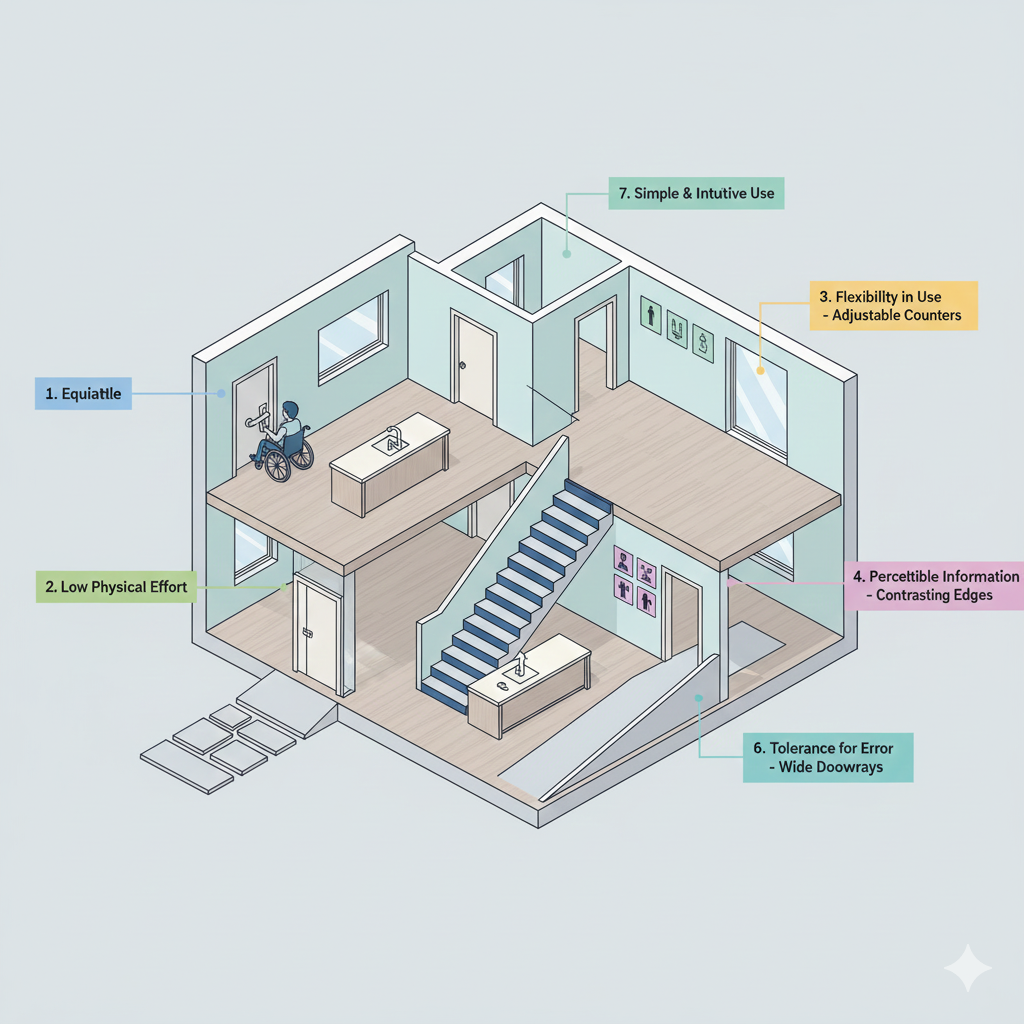
Developed in 1997 by a working group at NC State University, these 7 principles remain the gold standard for architects. Mastering Universal Design requires applying these filters to every sketch you draw.
1. Equitable Use
The design is useful and marketable to people with diverse abilities.
- The Goal: Avoid segregating or stigmatizing any users.
- Example: Power sliding doors at a grocery store. They work for the person in a wheelchair, the parent carrying a child, and the shopper with full hands. Everyone uses the same door.
2. Flexibility in Use
The design accommodates a wide range of individual preferences and abilities.
- The Goal: Provide choice in methods of use.
- Example: A museum desk that is adjustable in height, allowing an employee to work comfortably whether standing or seated.
3. Simple and Intuitive Use
Use of the design is easy to understand, regardless of the user’s experience, knowledge, language skills, or current concentration level.
- The Goal: Eliminate unnecessary complexity.
- Example: Intuitive wayfinding icons (like an arrow or a picture of a suitcase) at an airport that don’t require you to read English to find baggage claim.
4. Perceptible Information
The design communicates necessary information effectively to the user, regardless of ambient conditions or the user’s sensory abilities.
- The Goal: Use different modes (pictorial, verbal, tactile) for redundant presentation of essential information.
- Example: A fire alarm that flashes strobe lights (visual) while blaring a siren (auditory).
5. Tolerance for Error
The design minimizes hazards and the adverse consequences of accidental or unintended actions.
- The Goal: Arrange elements to minimize hazards.
- Example: The “Undo” button on a computer, or a car key that can be inserted into the ignition facing either up or down.
6. Low Physical Effort
The design can be used efficiently and comfortably and with a minimum of fatigue.
- The Goal: Allow users to maintain a neutral body position.
- Example: Lever door handles. You can open them with an elbow or a closed fist, unlike a round knob which requires tight grasping and twisting (impossible for someone with arthritis).
7. Size and Space for Approach and Use
Appropriate size and space is provided for approach, reach, manipulation, and use regardless of user’s body size, posture, or mobility.
- The Goal: Make it comfortable for seated or standing users.
- Example: Wide subway gates that accommodate a wheelchair, a service dog, or a traveler with luggage.
The “Curb Cut Effect”: Why Inclusion Helps Everyone
The strongest argument for Universal Design is economic and social, often illustrated by the “Curb Cut Effect.”
In the 1970s, disability activists fought for “curb cuts”—those dips in the sidewalk that allow wheelchairs to cross the street. Once they were installed, a strange thing happened.
- Parents with strollers used them.
- Travelers with rolling suitcases used them.
- Delivery workers with hand trucks used them.
- Skateboarders used them.
A feature designed for a small minority ended up benefiting the vast majority. This is the core truth of Universal Design: when you design for the margins, you improve the experience for the center. A ramp is better for a wheelchair user, but it’s also better for a tired architect carrying a heavy model.
Beyond Mobility: Designing for the Senses
When architects think of disability, they usually think of wheelchairs. But Universal Design must also account for the blind, the deaf, and the neurodivergent.
Designing for the Visually Impaired
It’s not just about Braille. It’s about texture and acoustics.
- Tactile Wayfinding: Changing the flooring material from smooth tile to textured carpet can signal to a blind person that they have entered a lobby or are approaching a reception desk.
- Acoustics: High-echo spaces are a nightmare for the visually impaired, who rely on sound cues to navigate. Absorptive materials help clarify the “sound map” of a room.
Designing for Neurodiversity
For people with autism or sensory processing disorders, the standard chaotic environment is overwhelming. Universal Design incorporates “sensory zoning.”
- Hyper-sensitive Zones: Quiet, dimly lit, acoustically dampened spaces for retreat (Refuge).
- Hypo-sensitive Zones: Bright, active, colorful spaces for stimulation (Prospect).

Real World Success: The Ed Roberts Campus
If there is a Mecca for Universal Design, it is the Ed Roberts Campus in Berkeley, California.
Designed by Leddy Maytum Stacy Architects, it is a community center for disability organizations. But you won’t find a “handicapped ramp” anywhere. Why? Because the entire building is a ramp.
- The Helical Ramp: A massive, sculptural red ramp spirals up the center of the atrium. It is the main way everyone gets to the second floor. It creates a shared experience of movement.
- Automatic Doors: Every door is automatic.
- Wayfinding: The floor patterns and lighting are high-contrast to aid those with low vision.
- The Result: It is a building that feels futuristic and welcoming, not “medical” or “compliant.” It proves that Universal Design can be high art.
The Future: Aging in Place
The global population is aging. By 2050, 1 in 6 people in the world will be over age 65 (16%). Universal Design is the key to “Aging in Place”—allowing people to stay in their own homes as they grow older, rather than moving to assisted living.
Architects must start designing “Forever Homes.”
- Zero-Step Entrances: No stairs to get in the front door.
- Reinforced Walls: Blocking inside bathroom walls so grab bars can be easily installed 20 years later.
- Wider Hallways: Corridors that are 42-48 inches wide to allow for future walker or wheelchair use.
Designing a home that works for a 30-year-old and an 80-year-old is the ultimate sustainable practice. It prevents the need for renovation or relocation.

Conclusion
Universal Design is an act of empathy. It requires the architect to step out of their own body and imagine the experience of a 7-year-old child, a 90-year-old grandmother, a pregnant woman, or a veteran with PTSD.
It challenges the ego of the designer. It asks us to stop prioritizing the “perfect form” and start prioritizing the “perfect experience” for the maximum number of people.
When we embrace Universal Design, we stop building barriers and start building bridges. We create spaces that don’t just tolerate diversity, but actively invite it. And in doing so, we build a world that is not just more accessible, but more human.
Frequently Asked Questions (FAQ)
Frequently Asked Questions (FAQ)
No. ADA (Americans with Disabilities Act) is a legal code that sets minimum standards (like door widths). Universal Design is a design philosophy that aims to exceed those standards to create environments usable by everyone seamlessly.
Does Universal Design cost more?
If it is an afterthought (retrofitting), yes. But if integrated from the beginning (e.g., grading the site so a ramp isn’t needed because the path is level), it often costs the same as traditional design. It also saves money long-term by reducing the need for renovations.
Can Universal Design be beautiful?
Absolutely. The Ed Roberts Campus and the High Line in NYC are examples of stunning architecture that is also universally designed. It forces creativity rather than laziness.
Who benefits from Universal Design?
Everyone. This is the “Curb Cut Effect.” While it is essential for people with disabilities, it improves the experience for parents, delivery workers, travelers, children, and the elderly.
What is the most overlooked aspect of Universal Design?
Sensory design. Architects often focus on mobility (ramps) but forget about acoustics (for the hard of hearing) or lighting/texture (for the visually impaired and neurodivergent).