Table of Contents
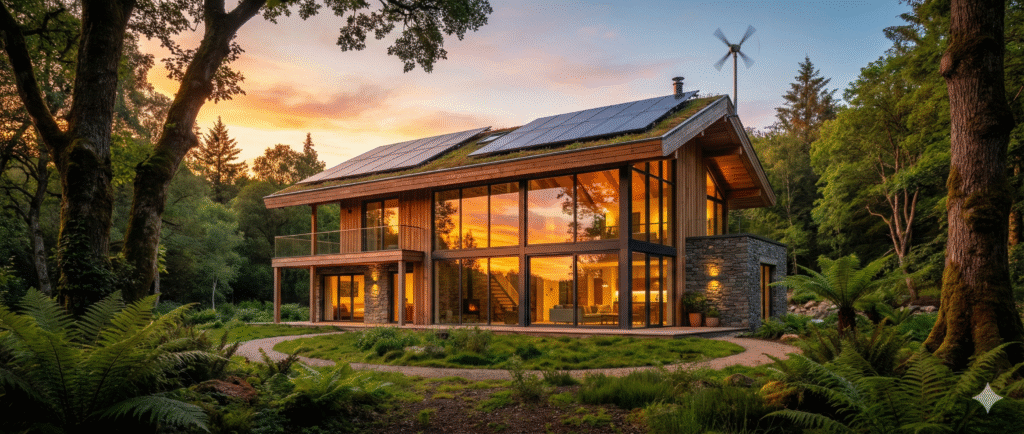
Off-grid buildings represent the ultimate dream for many modern homeowners and eco-conscious architects: total independence from public utilities and a harmonious relationship with the natural environment. As energy prices fluctuate and the desire for sustainability grows, the concept of disconnecting from the grid has moved from a niche lifestyle to a sophisticated architectural movement.
Designing off-grid buildings is not merely about installing a few solar panels; it is a holistic approach to architecture that integrates energy generation, water management, waste processing, and thermal comfort into a single, living system. In this comprehensive guide, we will explore the engineering, design principles, and lifestyle shifts required to create truly self-sufficient structures.
The Philosophy Behind Off-Grid Buildings
To understand off-grid buildings, one must first understand the philosophy of “autonomy.” In a traditional home, you are a consumer dependent on external infrastructure. In an off-grid home, you become a producer and a manager of your own resources.
The core pillar of off-grid buildings is resilience. By generating your own power and collecting your own water, you insulate yourself from grid failures, droughts, and economic volatility. However, this requires a shift in mindset. It requires “conscious consumption.” The most successful off-grid buildings are those designed not just to produce massive amounts of energy, but to require very little of it in the first place.
“The most sustainable energy is the energy you never have to use.”
This leads us to the first and most critical step in the design process: Passive Design.
1. Passive Solar Design: The Foundation
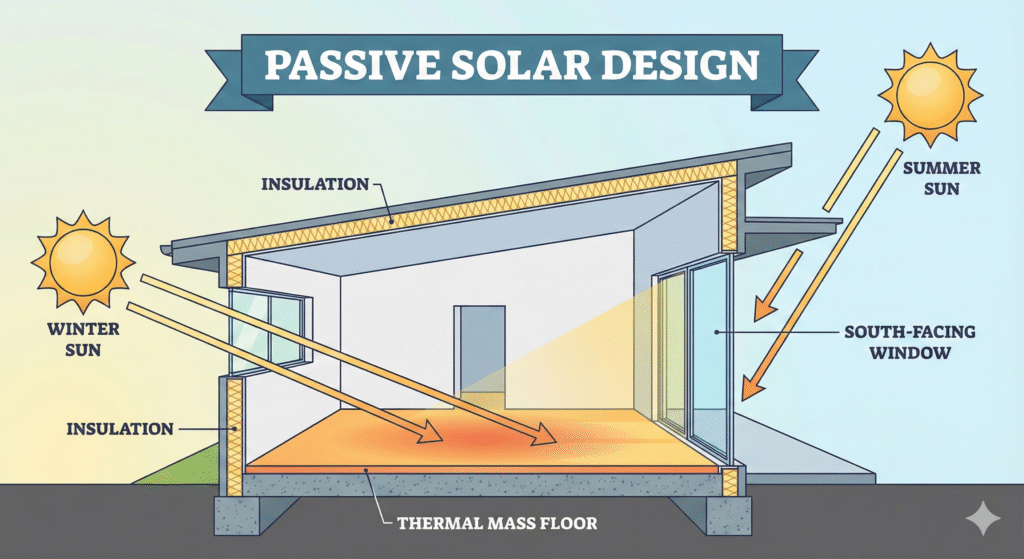
Before you buy a battery or a water tank, the geometry of off-grid buildings must be optimized. Passive solar design utilizes the sun’s energy for heating and cooling without mechanical systems.
Orientation and Glazing
For off-grid buildings in the northern hemisphere, the structure should be oriented with its longest axis facing south. This maximizes solar gain during the winter when the sun is low in the sky. Large, double or triple-glazed windows on the south side capture heat, while minimal glazing on the north side prevents heat loss.
Thermal Mass
Once the heat enters the building, it needs to be stored. Materials with high thermal mass—such as concrete, stone, or rammed earth—absorb heat during the day and release it slowly at night. This natural regulation stabilizes indoor temperatures, significantly reducing the load on HVAC systems, which are notoriously power-hungry in off-grid buildings.
Insulation and Airtightness
A self-sufficient home is essentially a thermos. High-performance insulation (targeting R-values well above code) and airtight construction prevent energy leaks. This is crucial because every kilowatt of heat lost through a drafty window is a kilowatt your solar system has to work harder to replace.
2. Renewable Energy Systems: Powering Independence
The beating heart of off-grid buildings is the power system. Since there is no utility line to fall back on, the system must be robust and redundant.
Solar Photovoltaics (PV)
Solar is the most common energy source for off-grid buildings. A properly sized array must account for the “worst-case scenario”—typically the darkest days of winter.
- Monocrystalline Panels: Higher efficiency and better for limited roof space.
- Bifacial Panels: Can capture reflected light from the ground (great for snowy climates).
Battery Storage Banks
Generating power is easy; storing it is the challenge.
- Lithium Iron Phosphate (LiFePO4): The current gold standard for off-grid buildings. They offer a long lifespan (10+ years), high depth of discharge, and safety.
- Lead Acid (AGM/Gel): Cheaper upfront but require more maintenance and have shorter lifespans.
Wind and Hydro Turbines
Solar isn’t always enough. Hybrid systems are the secret weapon of reliable off-grid buildings.
- Wind: Effective in open areas or coastal regions. Small turbines can generate power at night or during storms when solar is down.
- Micro-Hydro: If your property has a flowing stream with a sufficient “head” (vertical drop), hydro is the holy grail. It produces consistent power 24/7, unlike solar or wind.
| Energy Source | Pros | Cons | Best For |
| Solar PV | Silent, low maintenance, affordable | Weather dependent, needs batteries | almost all off-grid sites |
| Wind | Works at night/storms | Moving parts (maintenance), noise | Open plains, coasts |
| Micro-Hydro | 24/7 power generation | Site specific, regulatory hurdles | Properties with steep streams |
3. Water Management: Harvesting the Sky
In off-grid buildings, water is more precious than electricity. You cannot manufacture water; you can only collect and recycle it.
Rainwater Harvesting
The roof of your building is your catchment area. For every inch of rain on a 1,000-square-foot roof, you can harvest roughly 600 gallons of water. This water is channeled through gutters into a “first-flush” diverter (which removes debris) and then into large cisterns.
Filtration Systems
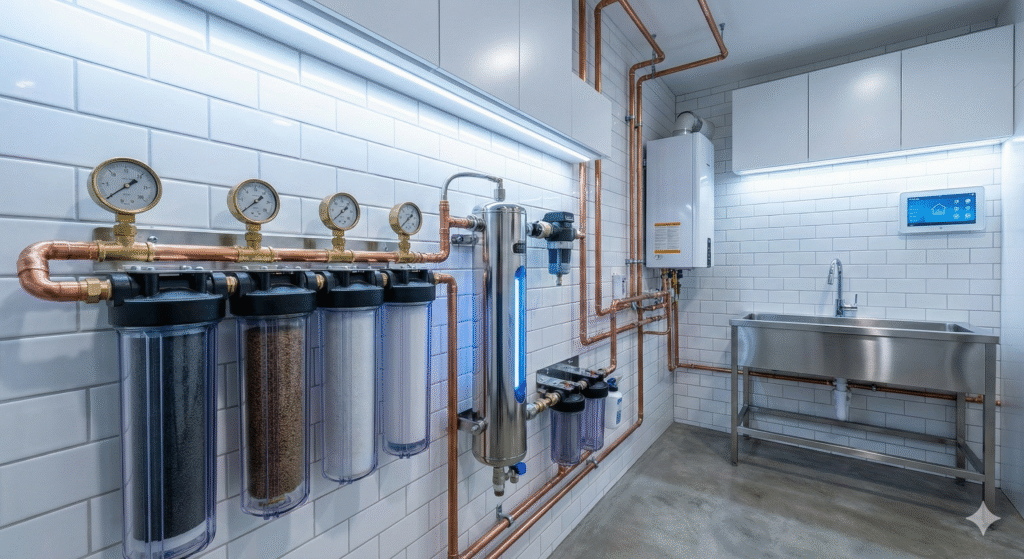
To make rainwater potable, off-grid buildings utilize multi-stage filtration:
- Sediment Filter: Removes dirt and rust.
- Carbon Filter: Improves taste and removes chemicals.
- UV Light or Reverse Osmosis: Kills bacteria and viruses.
Greywater Recycling
Water from sinks and showers (greywater) should not be wasted. In advanced off-grid buildings, this water is diverted to irrigate landscapes or flush toilets, effectively using every gallon twice.
4. Waste Management: Closing the Loop
Standard homes flush waste “away.” Off-grid buildings must deal with it on-site. This turns a problem into a resource.
Composting Toilets
Modern composting toilets are odorless and hygienic. They separate liquid and solid waste, allowing the solids to decompose into safe, nutrient-rich compost that can be returned to the earth. This drastically reduces water usage—a huge benefit for off-grid buildings.
Septic Systems
For those who prefer flush toilets, a septic system is required. It uses a bacterial environment to break down waste, with the effluent leaching into a drain field. However, this requires regular pumping and creates a dependence on outside services.
Biogas Digesters
For the ultra-sustainable, biogas digesters can take organic waste (food scraps and sewage) and convert it into methane gas, which can then be used for cooking. This is the epitome of a circular economy within off-grid buildings.

5. Heating, Ventilation, and Cooling (HVAC)
Since heating and cooling usually consume the most energy, off-grid buildings utilize alternative thermal methods.
- Rocket Mass Heaters: Highly efficient wood-burning stoves that burn fuel almost completely, directing the heat into a thermal mass bench that stays warm for days.
- Geothermal Systems: Utilizing the constant temperature of the earth to heat or cool the home. While expensive to install, they use significantly less electricity than standard heat pumps.
- Heat Recovery Ventilation (HRV): In airtight off-grid buildings, fresh air is vital. HRVs exchange stale indoor air for fresh outdoor air while retaining the heat (or cool) of the indoor air, ensuring efficiency.
6. The Challenges of Going Off-Grid
While the romanticism of off-grid buildings is strong, the reality presents hurdles.
The Cost Factor The initial capital required for off-grid buildings is higher than conventional homes. You are essentially buying 20 years of utility bills upfront in the form of batteries, panels, and tanks. However, the return on investment (ROI) is realized through the elimination of monthly bills and immunity to inflation.
Maintenance Living in off-grid buildings requires you to be part janitor, part engineer. Batteries need monitoring, filters need changing, and firewood needs chopping. It is an active lifestyle, not a passive one.
Zoning and Permits Many municipalities have building codes that mandate grid connection. Building off-grid buildings often requires navigating complex legal gray areas or moving to rural locations with more relaxed zoning laws.
Conclusion: The Future is Self-Sufficient
Off-grid buildings are more than just structures; they are a statement of independence and a commitment to the planet. They prove that we can live comfortably without extracting endlessly from the earth.
Whether you are looking to build a tiny cabin in the woods or a luxury autonomous villa, the principles remain the same: harvest what you need, store what you get, and waste nothing. As technology advances, off-grid buildings are becoming more efficient, more affordable, and more accessible, paving the way for a future where our homes take care of us, rather than us working to pay for our homes.
Are off-grid buildings legal everywhere?
No. Many urban and suburban areas have “Certificate of Occupancy” requirements that mandate connections to the electrical grid and sewer systems. You must check local zoning laws and building codes before planning off-grid buildings.
How much do off-grid buildings cost to build?
Generally, off-grid buildings cost 10-20% more upfront than traditional homes due to the cost of solar systems, batteries, and water tanks. However, the long-term savings on utility bills can offset this over time.
Can I have high-speed internet in off-grid buildings?
Absolutely. With the advent of low-orbit satellite internet (like Starlink), off-grid buildings can have high-speed connectivity anywhere on the planet, allowing for remote work and smart home monitoring.
What happens if my batteries run out?
A well-designed system usually has a backup generator (propane, diesel, or gasoline) that kicks in automatically to charge the batteries during extended periods of bad weather.
Do off-grid buildings have normal appliances?
Yes, but they prioritize efficiency. Off-grid buildings typically use propane for cooking and heating water to save electricity, and use highly efficient DC or Energy Star rated electric appliances for everything else.