Table of Contents
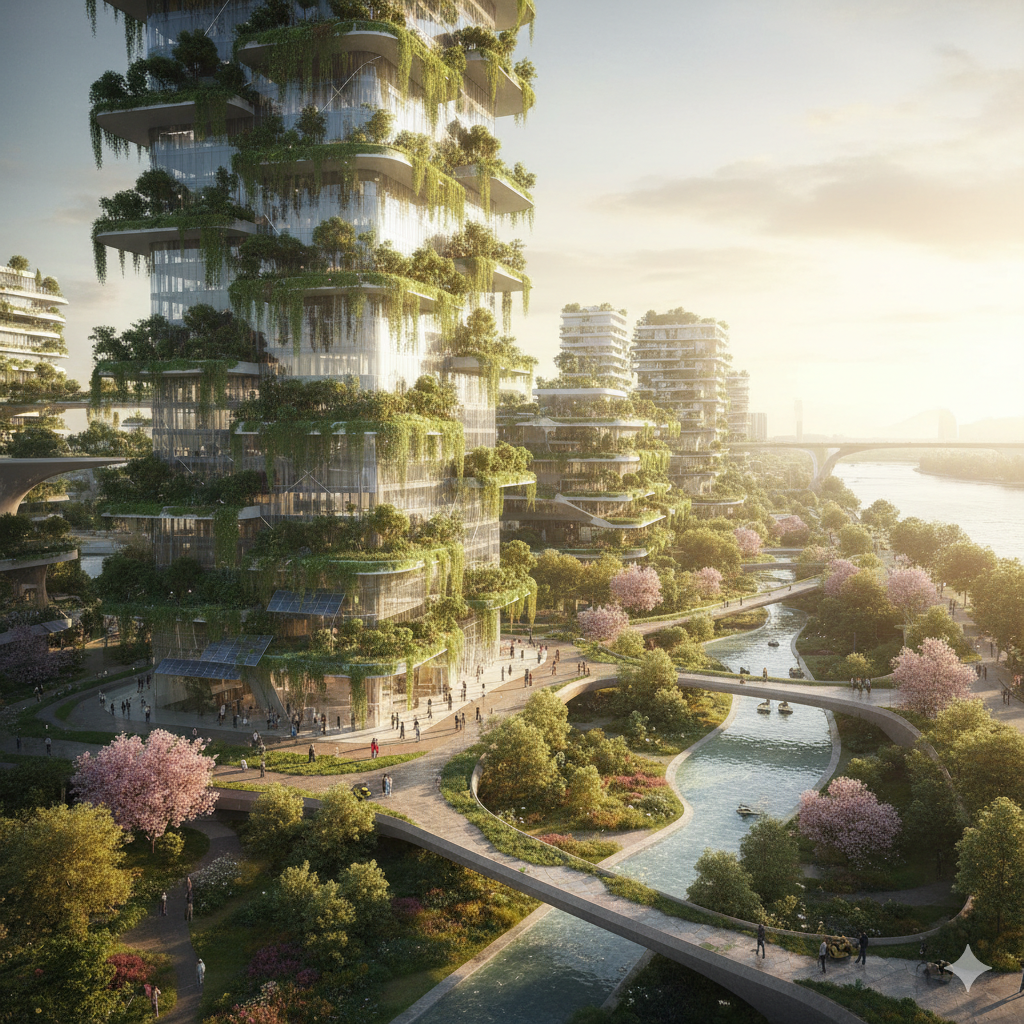
Water-Sensitive Urban Design (WSUD) is more than a trend; it’s a fundamental paradigm shift in how we conceive, design, and build our cities. For architects standing at the forefront of urban development, mastering the principles of WSUD is no longer optional—it is an essential toolkit for creating resilient, sustainable, and livable spaces for the future. In an era defined by climate change, rapid urbanization, and increasing pressure on natural resources, WSUD offers a holistic framework that treats water not as a problem to be drained away, but as a vital resource to be managed, celebrated, and integrated into the very fabric of our urban landscapes.
This guide will delve deep into the core tenets of Water-Sensitive Urban Design, providing architects with the practical knowledge, technical strategies, and inspirational case studies needed to champion this transformative approach.
What Exactly is Water-Sensitive Urban Design (WSUD)?
At its core, Water-Sensitive Urban Design is an approach to urban planning and design that integrates the management of the total water cycle into the urban development process. Traditionally, urban design has treated stormwater as a nuisance—something to be collected and rapidly expelled through a network of underground concrete pipes and channels. This “out of sight, out of mind” philosophy has led to a host of problems: flash flooding, pollution of rivers and oceans, degradation of natural ecosystems, and a disconnect between urban dwellers and the natural water cycles that sustain them.
WSUD flips this concept on its head. It advocates for managing rainwater where it falls, using a combination of natural systems and engineered solutions to slow down, filter, and store water within the landscape. This philosophy is built upon viewing stormwater, groundwater, and wastewater as valuable resources. By mimicking the hydrology of the natural landscape before development, Water-Sensitive Urban Design aims to minimize the environmental impact of urbanization and create cities that are not only more sustainable but also more beautiful, biodiverse, and resilient to the impacts of extreme weather events. It’s a move away from single-purpose, “grey” infrastructure (pipes and drains) towards multi-functional, “green” infrastructure that delivers ecological, social, and economic benefits simultaneously.
The Core Principles: The Foundation of WSUD for Architects
To effectively implement WSUD, architects must understand its foundational principles. These principles guide every design decision, from the master plan of a new district to the detailing of a single building.
- Protect and Enhance Natural Water Systems: Before any design work begins, the first step is to protect the existing natural water features of a site. This includes rivers, streams, wetlands, and aquifers. The design should work to restore and enhance these systems, not degrade or replace them. This principle emphasizes preserving natural drainage paths and riparian corridors as the backbone of the urban landscape.
- Integrate Stormwater Treatment into the Landscape: WSUD moves water management from hidden, underground networks to visible, integrated landscape features. Elements like rain gardens, swales, and constructed wetlands are designed to be beautiful public amenities that also function as natural water filters. This approach, often called a “treatment train,” uses a series of WSUD techniques to progressively clean stormwater as it moves through the site.
- Manage Water on Site (Decentralization): Instead of collecting stormwater and piping it to a centralized location, Water-Sensitive Urban Design promotes capturing and managing it as close to the source as possible. This is achieved through techniques like permeable pavements, green roofs, and rainwater harvesting systems, which reduce the volume and velocity of runoff, easing the burden on downstream infrastructure.
- Harvest and Reuse Water: WSUD recognizes water as a precious resource. The design should incorporate systems for harvesting rainwater and recycling greywater (from showers, sinks, and laundry) for non-potable uses like toilet flushing, irrigation, and urban cooling. This reduces the demand on municipal water supplies and creates a more circular water economy within a development.
- Create Multi-Functional, Resilient Infrastructure: Every element in a WSUD landscape should serve multiple purposes. A public square could be designed as a detention basin that temporarily holds water during a storm. A roadside swale can be both a beautiful garden and a stormwater conveyance and filtration system. This multi-functionality is key to making Water-Sensitive Urban Design cost-effective and space-efficient.
The Architect’s Toolkit: Key WSUD Techniques and Strategies
Now, let’s move from theory to practice. Here are some of the most effective and widely used WSUD techniques that architects can integrate directly into their projects.
1. Permeable and Pervious Surfaces
Traditional impervious surfaces like concrete and asphalt are a primary cause of urban runoff. Permeable surfaces are their sustainable alternative.
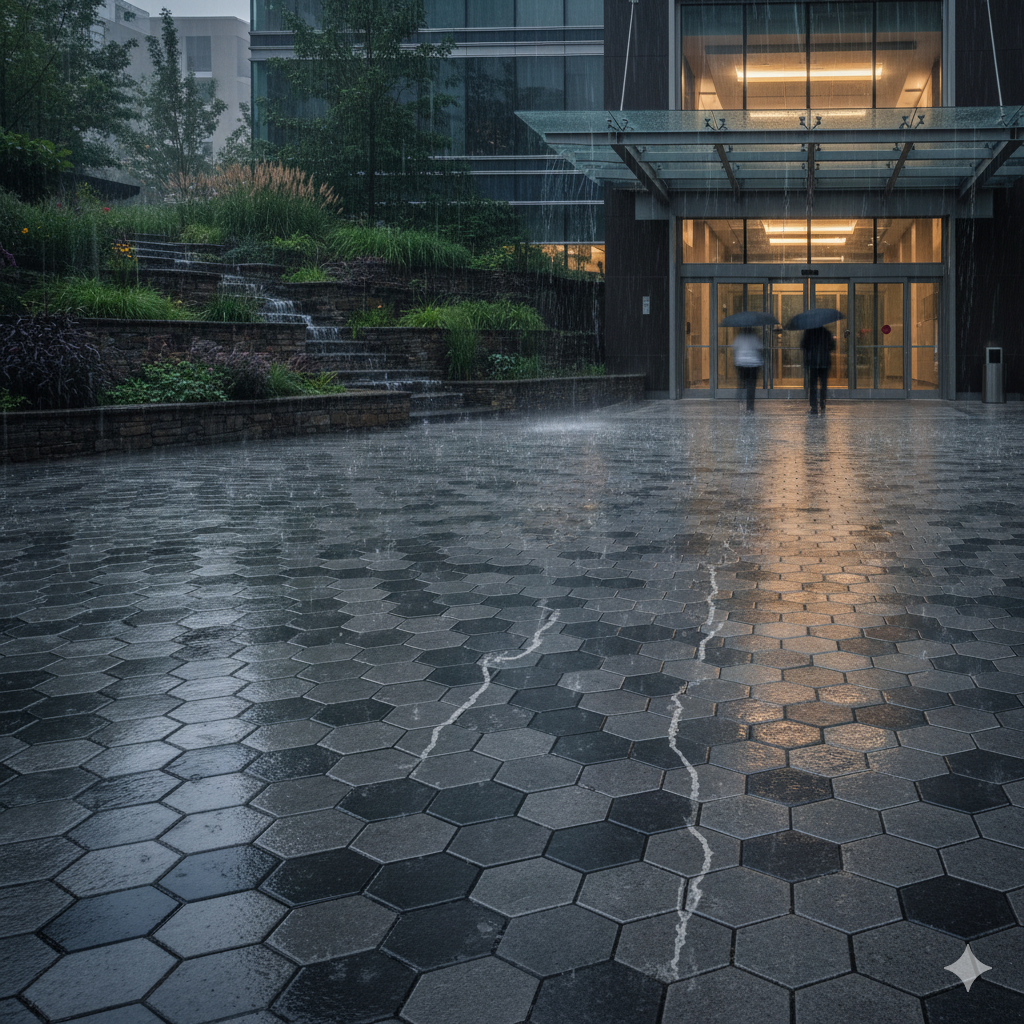
- What they are: These include permeable interlocking concrete pavers, porous asphalt, and resin-bound gravel. They are designed with voids that allow rainwater to pass through the surface into a subsurface storage layer, where it can slowly infiltrate into the ground.
- Architectural Application: Ideal for parking lots, driveways, pedestrian walkways, and public plazas. By replacing traditional hardscaping, you can eliminate surface runoff from these areas entirely, reducing the need for conventional drains and pits. It’s a critical strategy in effective Water-Sensitive Urban Design.
2. Green Roofs and Living Walls
Green roofs (or living roofs) are one of the most visible and impactful WSUD strategies.
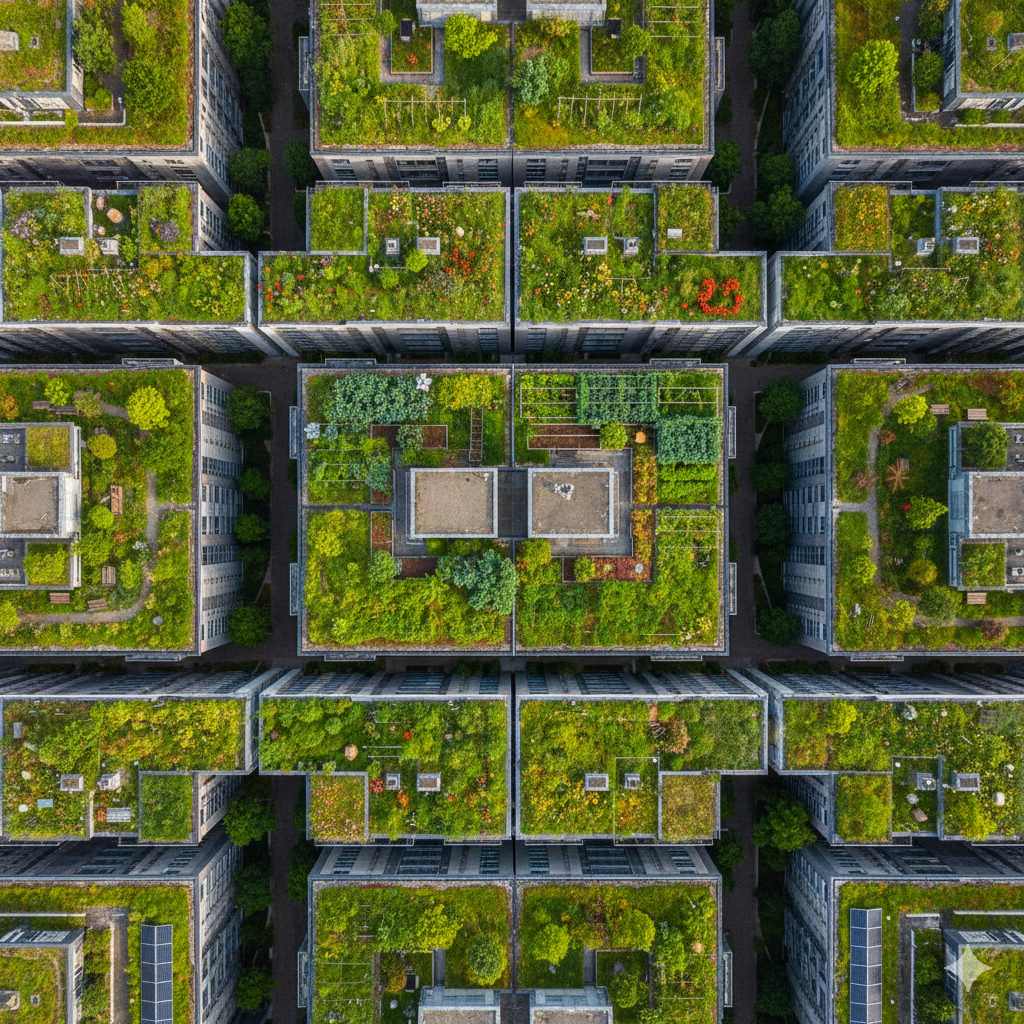
- What they are: A green roof is a layer of vegetation planted over a waterproofing membrane on a rooftop. They can be “extensive” (shallow, low-maintenance) or “intensive” (deeper, with a wider variety of plants, accessible as a park). Living walls are vertical greening systems attached to building facades.
- Architectural Application: Green roofs can be integrated into residential, commercial, and industrial buildings. They absorb significant amounts of rainfall, reducing runoff volume and delaying its peak flow. They also provide excellent thermal insulation, reduce the urban heat island effect, create habitats for biodiversity, and offer valuable amenity space.
3. Rain Gardens (Bioretention Systems)
Rain gardens are one of the most versatile and aesthetically pleasing WSUD tools.
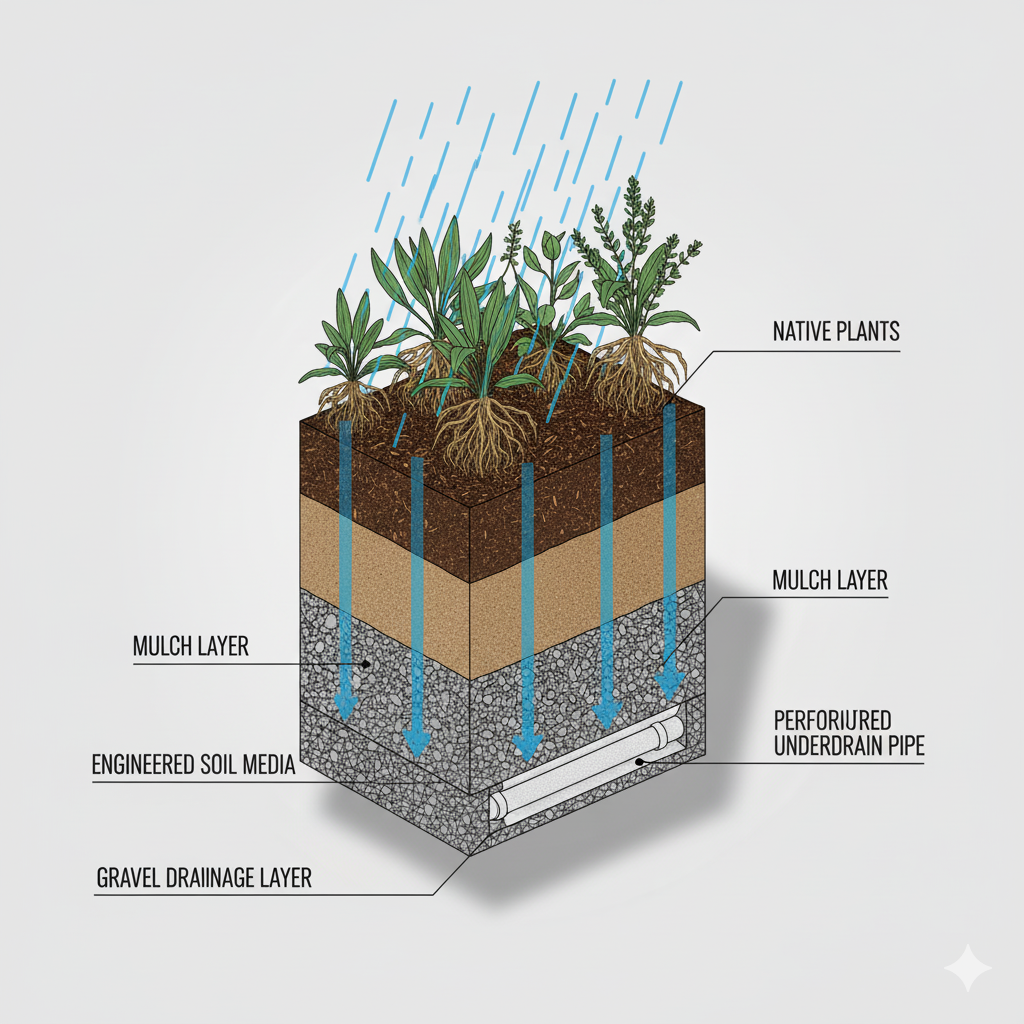
- What they are: These are shallow, landscaped depressions designed to collect, hold, and filter stormwater runoff from roofs, driveways, and other hard surfaces. They are planted with native vegetation that can tolerate both wet and dry conditions. Below the plants is a specially engineered soil media that filters pollutants.
- Architectural Application: Rain gardens can be scaled to fit almost any space, from a small residential garden to a large urban park. They are perfect for landscaping around buildings, in parking lot islands, and along streets. They are a cornerstone of a successful Water-Sensitive Urban Design implementation.
4. Swales and Infiltration Trenches
Swales are a simple yet highly effective way to manage and convey stormwater.
- What they are: Vegetated swales are broad, shallow channels designed to slow down stormwater, promote infiltration, and filter pollutants as the water flows through them. Infiltration trenches are gravel-filled ditches that temporarily store and infiltrate runoff.
- Architectural Application: Swales can be used to replace traditional curbs and gutters along streets and parking lots. They create linear green corridors that are far more attractive and ecologically functional than concrete channels. They can be designed to gracefully navigate a site’s topography, becoming a defining landscape feature.
5. Rainwater Harvesting and Greywater Recycling
This technique focuses on capturing water for reuse, reducing the strain on potable water sources.
- What it is: Rainwater harvesting involves collecting runoff from roofs in tanks or cisterns. Greywater recycling systems collect water from showers, laundry, and bathroom sinks, treat it, and then reuse it for non-potable purposes.
- Architectural Application: Rainwater tanks can be seamlessly integrated into a building’s design, either hidden or expressed as an architectural feature. The harvested water can be used for landscape irrigation, toilet flushing, and vehicle washing. Designing plumbing systems to separate greywater from blackwater (from toilets) at the source is a crucial step for enabling efficient recycling. This aspect of Water-Sensitive Urban Design directly contributes to water conservation goals.
Integrating WSUD into the Architectural Design Process
Adopting a Water-Sensitive Urban Design approach requires a shift in the typical design workflow. It’s not an add-on; it must be a consideration from day one.
- Site Analysis (The WSUD Lens): Begin with a thorough analysis of the site’s hydrology. Understand the topography, soil types, existing drainage paths, and natural water features. Identify opportunities for preservation, restoration, and integration. This analysis forms the foundation of your WSUD strategy.
- Conceptual Design: During the conceptual phase, let the water flow paths inform the layout of the site. Position buildings, roads, and open spaces to work with the natural topography. Sketch out the “treatment train”—how water will move from roofs to rain gardens, through swales, and eventually to a natural waterway or infiltration system.
- Material and Planting Selection: Choose materials that support your WSUD goals. Specify permeable pavers instead of standard concrete. Select native, drought-tolerant plant species for rain gardens and swales that can thrive in local conditions and provide maximum ecological benefit.
- Collaboration with Engineers: Close collaboration with civil and hydraulic engineers is critical. Architects bring the spatial and aesthetic vision, while engineers provide the technical calculations to ensure the systems are sized correctly and will perform as intended during different storm events. This interdisciplinary approach is vital for any Water-Sensitive Urban Design project.
- Long-Term Maintenance: Consider the long-term maintenance of the WSUD features. Design them to be robust and easily maintained. Provide clients with clear guidelines on how to care for green roofs, rain gardens, and permeable pavements to ensure their longevity and performance.
Case Studies: WSUD in Action
- Kallang River, Singapore: Once a utilitarian concrete canal, the Kallang River was transformed through a massive WSUD project into a naturalized, meandering river with accessible banks, parks, and bioretention systems. It improved water quality, increased biodiversity, and created a beloved public space.
- Ballast Point Park, Sydney, Australia: This post-industrial site was redeveloped using WSUD principles. It features extensive use of permeable surfaces, rain gardens to treat runoff from the Sydney Harbour Bridge, and rainwater harvesting for irrigation, showcasing how Water-Sensitive Urban Design can be used for brownfield regeneration.
- The High Line, New York City, USA: While famous as an elevated park, the High Line is also a superb example of a green roof. Its porous pathways and extensive planting beds absorb a huge amount of rainfall, significantly reducing stormwater runoff into the city’s overburdened sewer system.
The Future is Water-Sensitive
As architects, we are uniquely positioned to shape the future of our cities. The challenges of climate change—more intense rainfall, prolonged droughts, and rising temperatures—demand a new approach to design. Water-Sensitive Urban Design provides a powerful, proven framework for creating cities that are not just sustainable but also more equitable, healthy, and inspiring. By embracing water as a central element of design, we can create buildings and landscapes that restore natural systems, build community resilience, and leave a positive legacy for generations to come. The question is no longer if we should adopt WSUD, but how quickly we can make it the standard for all urban development.
Frequently Asked Questions (FAQ)
Is Water-Sensitive Urban Design more expensive than traditional drainage?
While some WSUD elements might have a higher initial capital cost, they often result in significant long-term savings. Costs are offset by reduced spending on traditional pipe infrastructure, lower water bills through harvesting and reuse, and increased property values. Furthermore, the social and environmental benefits, like improved public health and biodiversity, provide immense value that isn’t captured in a simple cost analysis.
Can WSUD be applied to existing urban areas (retrofitting)?
Absolutely. While it’s easiest to implement in new developments, retrofitting is a huge and growing area of WSUD. This can involve projects like converting traditional streetscapes into “green streets” with swales and permeable parking lanes, installing green roofs on existing buildings, or transforming underutilized public spaces into stormwater parks.
Does WSUD work in all climates?
Yes, the principles of Water-Sensitive Urban Design are universal, but the specific techniques must be adapted to the local climate. In arid regions, the focus might be more on rainwater harvesting and creating oasis-like microclimates. In regions with heavy rainfall, the focus will be more on flood mitigation and managing large volumes of water through infiltration and detention systems.
What is the difference between WSUD, SUDS, and LID?
These terms are very similar and often used interchangeably. WSUD (Water-Sensitive Urban Design) is the term most commonly used in Australia and is considered a very holistic framework. SUDS (Sustainable Urban Drainage Systems) is the equivalent term used in the UK. LID (Low Impact Development) is the term predominantly used in North America. All three share the same core philosophy of managing stormwater at its source using green infrastructure.